
Completing a certified generative ai online course is a significant accomplishment. However, passive video comprehension does not convince engineering hiring managers or clients—applied proof does.
To convert theoretical understanding into demonstrable capability, you must build original, self-directed projects. A compact, thoroughly evaluated application with clear error boundaries is infinitely more persuasive than a complicated demo that breaks during live evaluation.
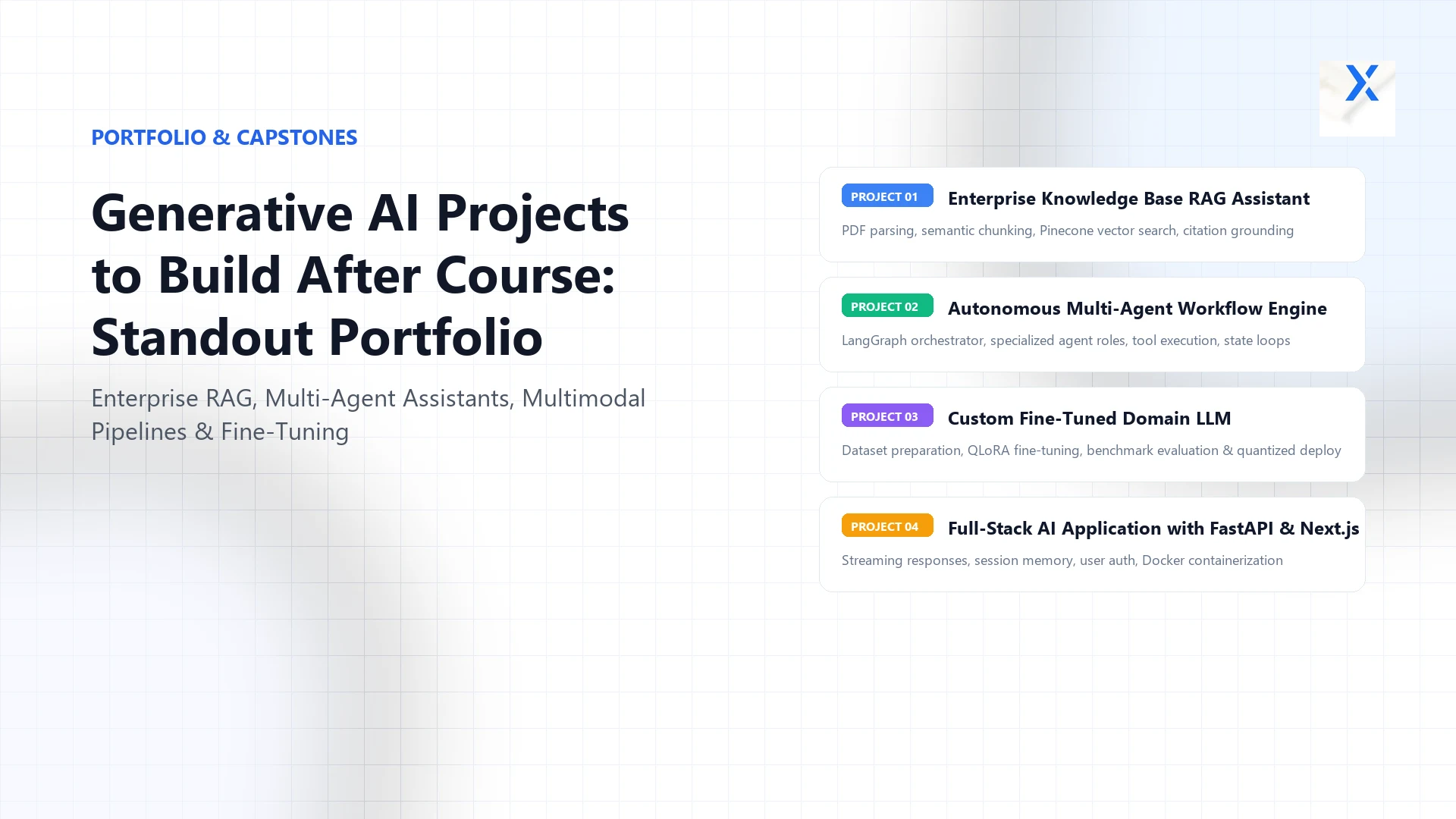
This guide outlines eight practical project blueprints—ranging from lightweight prompt workflows to enterprise Retrieval-Augmented Generation (RAG) applications—along with testing methods and portfolio documentation standards.
1Why Build Projects After Your Course?
Online courses provide curated sandboxes where dependencies rarely break and edge cases are simplified. Building independently forces you to confront real-world engineering hurdles:
Handling Rate Limits & Latency
Balancing token consumption, model response latency, and asynchronous timeouts in production.
Defending Against Hallucination
Implementing grounded context, source attribution, and deterministic verification logic.
Controlling API Token Costs
Designing compact prompts, vector retrieval thresholds, and cached responses to stay cost-efficient.
Demonstrating Practical Initiative
Proving to hiring teams that you can formulate a business problem and engineer a complete technical solution.
2Eight Practical Generative AI Project Ideas
Document Summarisation Assistant
Build a pipeline that ingests long-form non-sensitive documents (e.g., industry whitepapers, research articles) and produces a hierarchical summary: an executive brief, bulleted takeaways, and critical open questions.
Personal Study & Flashcard Generator
A tool that takes class or meeting notes, parses out conceptual terms, and generates Anki-compatible flashcards along with multiple-choice self-quizzes.
Guardrailed Customer FAQ Assistant
A conversational bot that answers user queries strictly based on an approved FAQ knowledge base. It must provide clear fallbacks when answers are not found rather than making up answers.
Retrieval-Augmented Generation (RAG) Knowledge Engine
Build a complete vector search pipeline. Ingest internal PDFs, implement recursive chunking, compute embeddings, store them in a vector database (e.g., Chroma or Pinecone), and retrieve relevant chunks with exact citation footnotes.
Multi-Channel Content Planning Workflow
An automated pipeline that transforms a single high-level product announcement into an entire monthly content strategy—including blog outlines, social threads, and newsletter copy.
Meeting Transcript Action-Item Organiser
Parses meeting transcripts to extract verified decisions, explicitly assigned action items with owners and deadlines, and unresolved parking-lot items.
AI-Assisted Multi-Source Research Organiser
Ingests multiple conflicting articles or market reports on a topic, synthesizes consensus findings, and highlights points of direct disagreement between sources.
Full-Stack AI Application with API Integration
Build a working web app (e.g., React front-end, Node/Python back-end) that connects to an LLM provider. Implement input sanitization, streaming responses, user authentication, and secure server-side API key handling.
3Project Selection Framework
Before writing code or prompts, vet your project concept using these six qualification questions:
Is the problem narrowly defined, or is it an overly ambitious 'do-everything' assistant?
Can I easily obtain realistic, non-confidential test data?
Do I have clear criteria to tell whether an output is objectively correct?
Does the technical difficulty match my current skills, with room for stretch learning?
Can I build a working Minimum Viable Prototype (MVP) within 1-2 weeks?
Can I clearly explain the trade-offs, architecture, and limitations during an interview?
4How to Document Projects for Your Portfolio
A great project without documentation is invisible. Structure your GitHub README or case study writeup using this proven layout:
Standard Portfolio Case Study Structure:
- Problem Statement: The concrete business or operational pain point addressed.
- System Architecture: Diagram showing model choice, embeddings, vector storage, and data flow.
- Key Engineering Decisions: Why you chose specific chunking sizes, prompt guardrails, or model tiers.
- Testing & Evaluation: Test case numbers, hallucination rates, and benchmarking results.
- Known Limitations & Next Steps: Where the system fails, edge cases discovered, and future roadmap.
- Live Demo / Video Walkthrough: A 2-minute Loom video or public deployed link.
5Common Project Pitfalls to Avoid
- Hardcoded API Keys: Never commit secrets to public GitHub repos. Use environment variables.
- The "Single Cherry-Picked Prompt": Never validate system quality on one successful prompt demo. Test edge cases and malformed inputs.
- Uploading Confidential Data: Never train or test models using proprietary corporate data without explicit enterprise compliance agreements.
Review our guide on choosing a generative ai online course with certificate to understand how to balance credentials with demonstrable portfolio projects.
6Frequently Asked Questions
7Conclusion & Next Steps
Projects bridge the gap between classroom theory and real-world employment. Pick one blueprint from this guide that excites you, build a working prototype, document your edge cases and findings, and share it with peers for feedback.
If you want hands-on mentorship building production-grade RAG and agent architectures with live code reviews, explore AcceleratorX’s applied courses.