
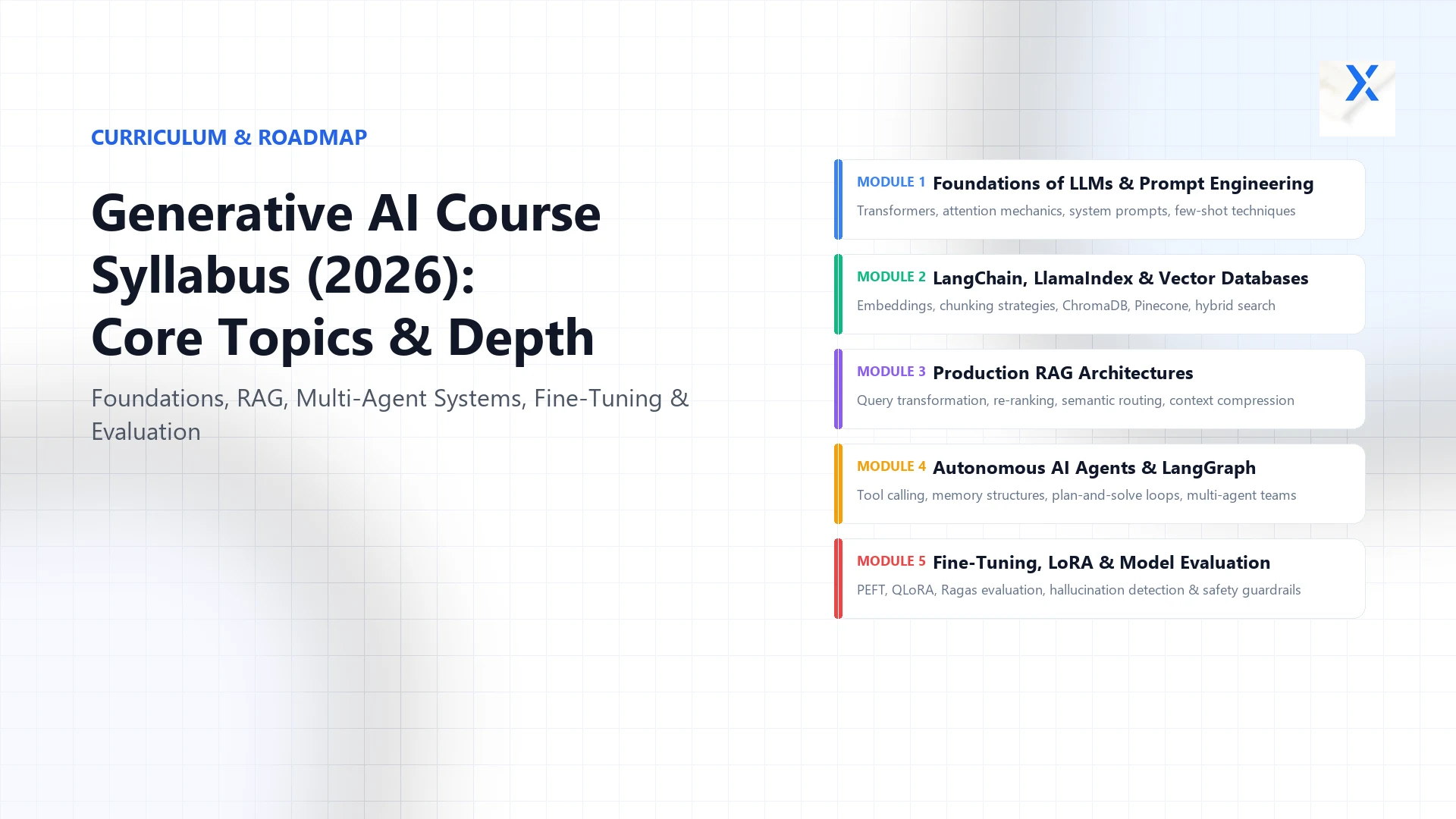
When selecting a generative ai online course, the course title alone rarely reveals what you will actually learn. One program might teach non-technical professionals how to use commercial AI tools for office productivity, while another trains software engineers to build scalable, multi-agent enterprise applications with language models.
To make an informed investment, you must closely examine the syllabus. This guide provides a modular checklist covering fundamentals, applied tooling, core LLM concepts, RAG architectures, agentic workflows, safety protocols, and portfolio projects.
Use this guide to audit prospective curricula. Start by identifying your personal learning objective—whether you are a beginner exploring the field or an experienced developer—and verify which modules are essential versus optional for your goals.
1Module 1: Generative AI Fundamentals & Prompting
A robust introductory module establishes conceptual clarity by demystifying foundational terms and exploring the operational differences between predictive and generative models across text, image, audio, and code.
Core Competencies Taught:
Key takeaway: High-quality courses teach repeatable problem-solving frameworks rather than simply providing static lists of prompt hacks.
2Module 2: Generative AI Tools & Workflows
Commercial AI tools update rapidly. A strong curriculum teaches transferable methodologies alongside specific platform demonstrations so your skills remain adaptable as interfaces change.
Writing & Research
Literature review, technical documentation drafting, structured summarization, and tone adaptation.
Coding & Debugging
Code generation, test case synthesis, legacy refactoring, and AI-assisted terminal scripting.
Multi-Modal Media
Visual asset generation, speech synthesis, document vision parsing, and video storyboard design.
3Module 3: LLM Concepts, Embeddings & RAG
For learners moving into engineering and software development, understanding the underlying mechanisms of language models is crucial. This module separates basic UI chat users from engineers building production software.
Technical Deep-Dive Topics:
- Tokenization & Context Windows: Calculating context limits, understanding cost per million tokens, and sliding-window strategies.
- Inference Hyperparameters: Balancing Temperature, Top-P, frequency penalties, and structured JSON mode.
- Vector Embeddings: High-dimensional vector space, cosine similarity, and semantic clustering.
- RAG Pipeline Architecture: Document parsing, recursive chunking strategies, vector database indexing (Chroma, Pinecone, pgvector), retrieval reranking, and source attribution.
4Module 4: AI Agents & Workflow Automation
Modern AI development has shifted toward agentic architectures—systems where models plan multi-step execution paths, invoke external functions, inspect intermediate results, and iterate autonomously.
Tool Calling & Function Execution
Connecting LLMs to live SQL databases, web search engines, REST APIs, and file systems.
State Management & Memory
Handling short-term conversation state, persistent user memory, and multi-turn transaction logic.
Multi-Agent Collaboration
Role-playing hierarchies (Researcher, Writer, Reviewer) and consensus workflows.
Safety & Guardrails
Preventing infinite execution loops, rate limit throttling, and human-in-the-loop review.
5Module 5: Evaluation, Benchmarks & Responsible AI
Building a prototype is easy; guaranteeing accuracy, safety, and compliance in production is hard. A comprehensive syllabus dedicates significant time to empirical testing and ethical governance.
Systematic Evaluation: Automated test suites, ground-truth benchmarking, and LLM-as-a-judge scoring frameworks.
Factuality & Grounding: Detecting hallucinations and enforcing verifiable citations in knowledge retrieval.
Data Privacy & Governance: Enterprise data retention policies, zero-data-logging agreements, and PII masking.
Prompt Injection Defense: Shielding system instructions from adversarial user inputs and jailbreaks.
6Module 6: Capstone Projects & Portfolio Building
Hands-on projects cement conceptual understanding and give you tangible artifacts to show employers or clients. Review our complete guide to generative AI projects to build after your course for detailed blueprints.
Enterprise Document Assistant
A RAG-powered portal that indexes internal PDFs and policy documents with exact page-level citations.
Multi-Source Research Agent
An autonomous agent that searches the web, verifies sources, and synthesizes structured executive briefs.
7How to Compare Different Course Syllabi
Consider this common scenario when comparing online programs:
Lists 25+ commercial tools (ChatGPT, Midjourney, Jasper, Runway, etc.) with brief 5-minute video demos. Covers wide surface area but provides very little engineering depth, feedback, or custom implementation.
Focuses deeply on Python LLM APIs, LangChain, vector search, and evaluation. Requires submitting a working, tested RAG application and provides weekly mentor feedback. Gives far stronger real-world competency.
Before paying, request sample lesson recordings, confirm access length, and verify whether a verified completion certificate is included upon project review.
8Frequently Asked Questions
9Conclusion & Next Steps
A great generative AI syllabus combines clear learning outcomes, logical topic sequencing, practical project work, and responsible governance. Evaluate depth based on your career trajectory rather than simply counting the number of buzzwords on a landing page.
Take a few minutes to write down your core objectives. If you want structured, industry-aligned training covering both prompt engineering and end-to-end agentic application engineering, compare AcceleratorX’s current curriculum against this checklist.