
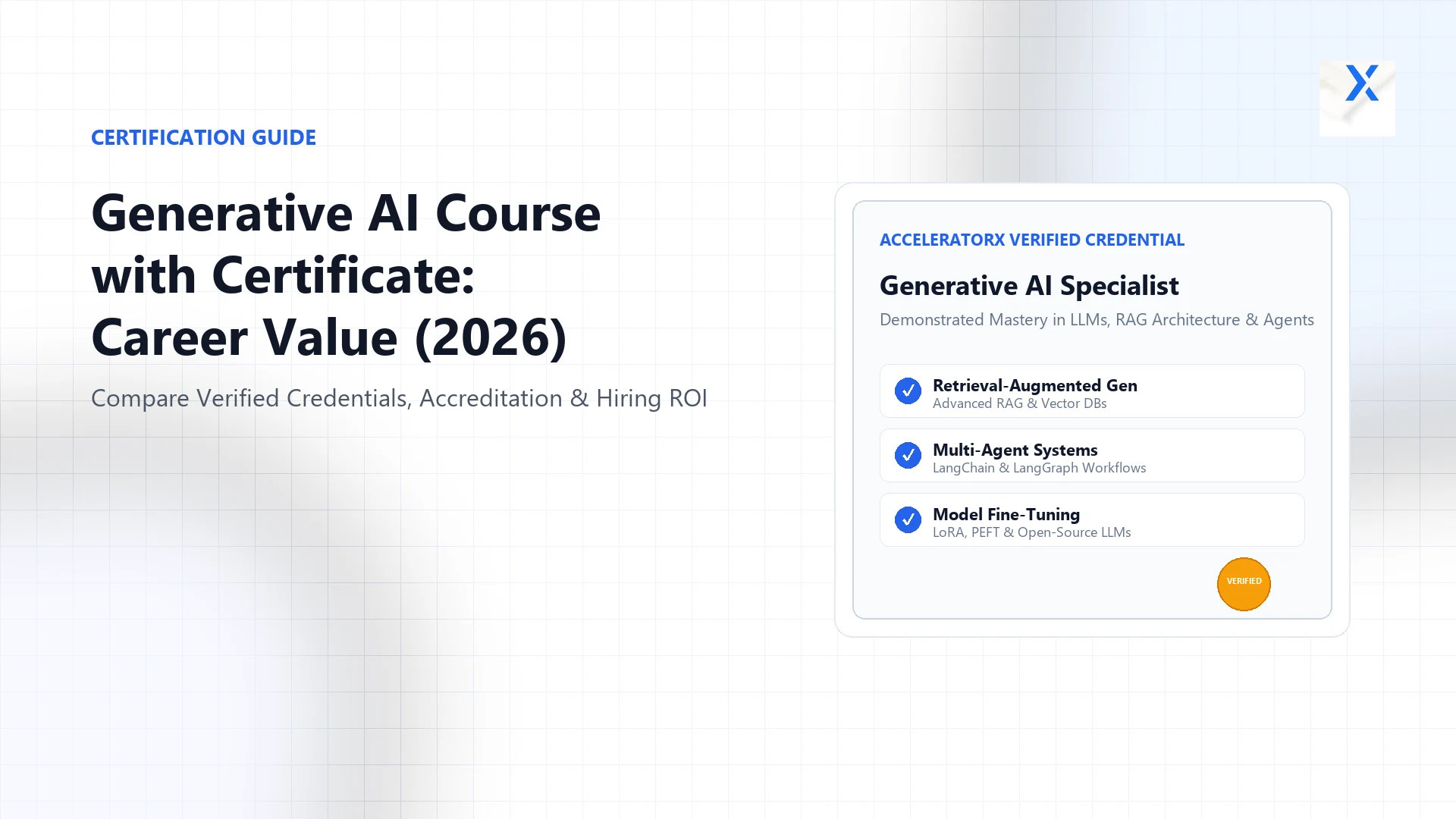
Many learners search for a generative AI course online with a certificate because they want structured learning and tangible proof of completion. Certificates can meet this need, but they come in very different formats and carry varying levels of industry weight.
The three primary types of credentials you will encounter are attendance certificates, which show that you finished the course; assessment-based certificates, which require you to pass rigorous quizzes or coding tests; and professional or institutional certificates, which accredited universities or recognized tech enterprises award to signal verified achievement. Understanding these differences ensures you set realistic career expectations before enrolling.
Some organisations validate simple attendance, while others require quizzes, assignments, or portfolio projects. It is crucial to remember that a certificate does not automatically equate to an industry licence, an academic degree, or evidence of senior-level mastery. Before you enroll, take time to verify the issuing body, the assessment criteria, and the curriculum requirements.
1Types of Course Certificates
1. Completion Certificates
Given when you watch lesson videos or complete reading modules. They verify course engagement and interest rather than tested proficiency.
2. Assessment-Based
Requires passing graded problem sets, real-world case studies, or prompt engineering capstones. Proves demonstrable comprehension.
3. Institutional Credentials
Awarded in collaboration with university continuing education wings or cloud tech giants. Best verified through official registries or digital badge systems.
Tip for Credential Verification: To confirm whether a credential is acknowledged across the industry, look for an official verification link (e.g. Credly or university registrar records) and ask the provider for sample documentation before enrolling.
2What to Consider When Choosing a Certificate Program
Always prioritize the underlying learning experience over the digital certificate itself. A certificate is only as reputable as the educational depth behind it. Evaluate prospective courses using the following quality pillars:
Curriculum Transparency
A detailed syllabus that explicitly breaks down tools, models, APIs, and business use cases.
Expert Instructors
Practicing machine learning engineers or enterprise product leaders with active domain experience.
Hands-On Deliverables
Assignments that require building real AI workflows rather than purely multiple-choice questions.
Transparent Fees
Clear upfront pricing without hidden assessment fees or extra charges for certificate verification.
Sustained Access
Clear guidelines on how long you retain access to course recordings, prompt templates, and communities.
Responsive Mentor Support
Available office hours, dedicated Slack or Discord channels, or live code reviews for questions.
Be sure to review the complete generative AI course syllabus to ensure the depth aligns with your career goals.
3How to Evaluate the Certificate Itself
Before paying for tuition, audit the certificate terms by asking these fundamental questions:
Who officially issues the certificate? Is it the teaching academy, an individual creator, or an accredited partner institution?
What exact requirements must be satisfied? Does it require 100% video completion, graded quizzes, or a defended capstone project?
Can the certificate be verified digitally? Does it include a unique hash, QR code, or permanent URL for employers to check?
Are there additional testing or re-submission fees if you need to retake a practical assessment?
Does the certificate state the specific skills tested (e.g., Prompt Engineering, RAG Systems, Multi-Agent Workflows) or merely a generic course title?
4Skills Matter Alongside Credentials
A certificate is an introduction, but your technical and applied skills are what sustain an interview and deliver business value. When preparing your profile, ensure your training covers the following practical domains:
Core Applied Competencies
- Structured prompt engineering with guardrails
- Understanding model hallucination and token limits
- Automated content verification and benchmark testing
- Data privacy, security, and IP governance in AI
Technical Implementation
- API integration with OpenAI, Claude, and local models
- Vector embeddings and semantic search indexing
- Retrieval-Augmented Generation (RAG) pipelines
- Deployment of multi-agent autonomous automations
5Certificate vs. Portfolio Project: Side-by-Side
Both credentials and portfolio projects serve distinct purposes in validating your capabilities to peers and employers:
| Factor | Course Certificate | Portfolio Project |
|---|---|---|
| Primary Purpose | Documents lesson completion or exam score | Demonstrates hands-on applied problem solving |
| Visual Proof | Shows provider logo and certificate ID | Shows code repository, live UI, and output quality |
| Verification | Instant verification via platform link | Reviewed for architecture, depth, and clean code |
| Assessment Rigor | Depends on course creator standard | Depends on complexity, edge cases, and documentation |
| Hiring Impact | Validates interest and basic familiarity | Key differentiator during technical interviews |
6How to Compare Online Certificate Courses
To choose the right program, build a simple comparison sheet evaluating shortlisted courses on equal footing:
Key Criteria to Track:
- Total fee including applicable taxes
- Prerequisites and necessary math/programming background
- Evaluation method (graded project vs multiple choice)
- Issuing organization and certificate format
Red Flags to Watch For:
- Guaranteed 100% job placement claims
- Universal government accreditation claims without proof
- Extra mandatory charges to release certificate
- Lack of publicly visible sample syllabi or lesson previews
For a detailed analysis of typical course pricing, review our companion guide on generative AI course fees in India.
7Frequently Asked Questions
8Conclusion & Final Recommendations
An online generative AI certificate can serve as valuable documentation of your dedication and systematic study. However, its ultimate industry significance depends on the rigor of the provider, the difficulty of the assessments, and your ability to apply the skills in practical scenarios.
Start by evaluating the syllabus, hands-on labs, and instructor credentials. Prioritize real-world projects that you can showcase on GitHub or your portfolio, and consider the certificate as an earned milestone. If you are exploring comprehensive programs with verified hands-on credentials, evaluate AcceleratorX’s current curriculum and project requirements against these benchmarks.