
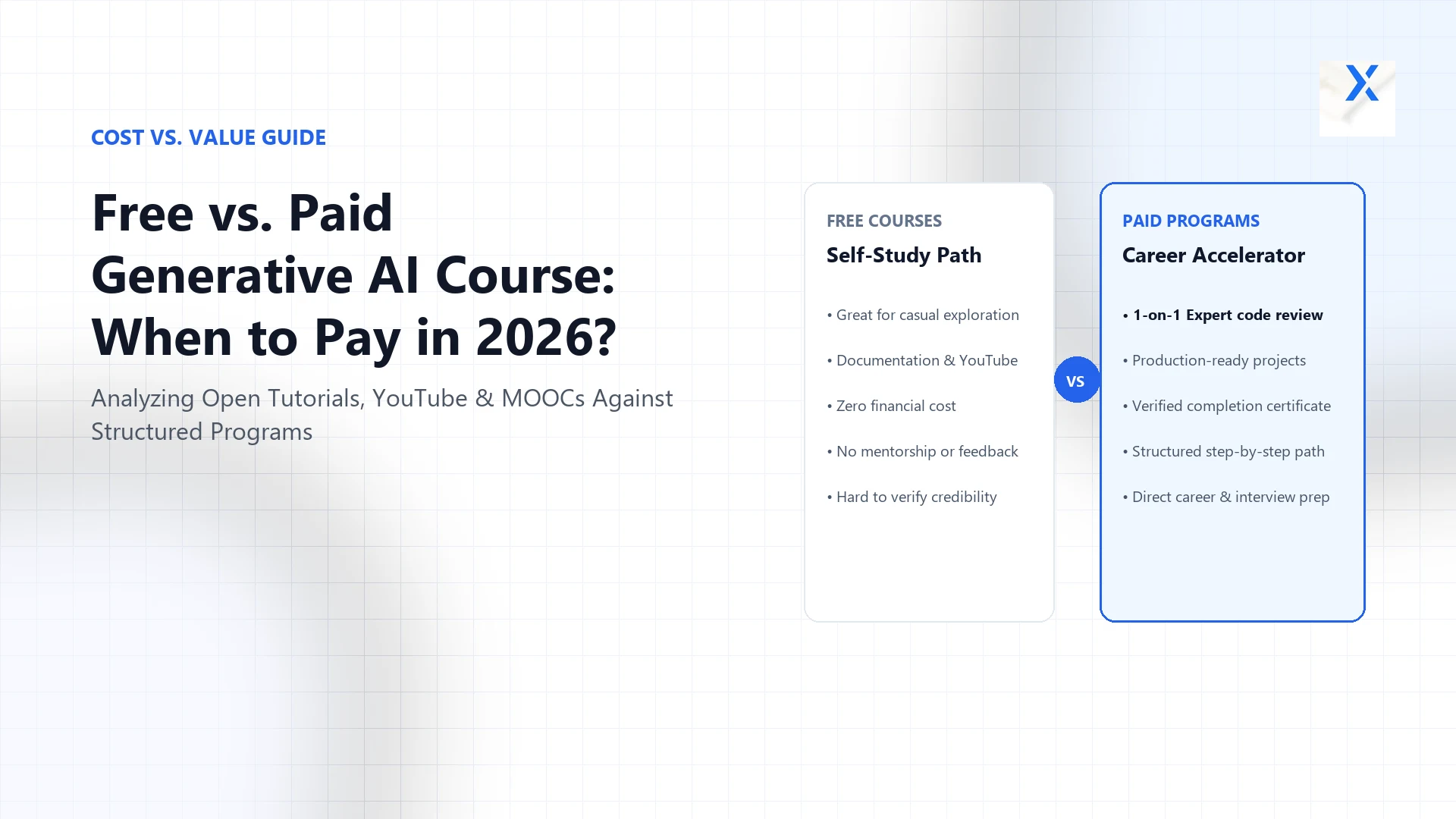
You can begin learning artificial intelligence through free open-source resources, premium paid bootcamps, or a smart hybrid combination of both.
If you are entirely new to the field, jumping straight into a high-cost program is rarely necessary. Exploring reputable free introductory modules gives you immediate hands-on experience with core concepts before you make any financial commitment.
When comparing free resources against a paid generative ai online course, focus on what each path actually provides. Free content offers high flexibility with zero risk, while paid programs package learning into structured sequences with human mentorship and code reviews. Neither route guarantees success on its own.
1What Free Classes and Materials Offer
Free learning includes developer documentation (OpenAI/Anthropic docs), interactive code cookbooks, open video courses, and community Discord servers.
Possible Benefits
- Zero Financial Commitment: Experiment risk-free across multiple topics.
- Broad Exploration: Test whether you prefer prompt engineering, data analytics, or LLM development before specializing.
- Direct Tool Documentation: Official API guides are authored directly by model creators and updated frequently.
- Modular Flexibility: Combine tutorials from different creators to fill precise knowledge gaps.
Possible Limitations
- Fragmented Information: Content is scattered across dozens of blog posts and repos.
- No Clear Learning Progression: Easy to get stuck in tutorial loops without mastering end-to-end architecture.
- Zero Instructor Feedback: You must troubleshoot complex syntax and model errors independently.
- Outdated Examples: Video tutorials created 6 months ago may reference deprecated SDK syntax.
- No Graded Credentials: Unlike a structured generative ai online course with certificate, free materials rarely offer verified assessments or formal portfolio credentials.
2What Paid Courses Add (And Their Limits)
Paid programs package lessons into an organized curriculum with assignments, live sessions, code reviews, and structured capstones.
Possible Advantages
- Defined Path from A to Z: Curated curriculum designed to take you from foundational concepts to production deployment.
- Scheduled Mentorship: Direct office hours and interactive Q&A to resolve roadblocks fast.
- Guided Project Reviews: Industry mentors evaluate your GitHub code and give actionable feedback.
- Centralized Accountability: Clear milestone deadlines prevent procrastination.
Possible Limitations
- Upfront Tuition & Extra Costs: Financial investment plus potential API and tool fees.
- Variable Quality: High prices do not guarantee exceptional teaching or up-to-date models.
- Limited Flexibility: Scheduled cohort sessions can clash with full-time corporate demands.
Always inspect the complete course syllabus before paying. Never assume that every paid course automatically includes personal mentorship.
3Free vs. Paid: Side-by-Side Comparison Table
| Comparison Factor | Free Resources | Structured Paid Courses |
|---|---|---|
| Tuition Cost | Zero tuition (API tokens may apply) | Tuition + possible tool expenses |
| Curriculum Structure | Fragmented across disparate blogs/repos | Sequenced step-by-step roadmap |
| Schedule Flexibility | 100% self-paced | Varies (self-paced, live, or blended) |
| Instructor Feedback | None or async forum crowdsourcing | Direct mentor office hours & code reviews |
| Capstone Projects | Self-invented and unreviewed | Guided industry briefs with grading |
| Credential / Certificate | Rarely provided or unverified | Digital verifiable certificate upon review |
| Content Maintenance | Depends entirely on creator updates | Managed update cycles by academy |
| Best Use Case | Initial discovery & self-driven study | Career transition, production engineering |
4When Free Learning Is Sufficient
Free resources are an excellent starting point if you are:
- Testing your interest in AI before allocating a budget.
- Learning basic prompt crafting for personal writing, summarization, or study flashcards.
- An experienced software engineer capable of reading official SDK documentation and troubleshooting errors independently.
- Updating your knowledge on minor tool feature releases.
5When a Paid Program Is Worth the Investment
Consider investing in a paid program when:
- You need an organized, step-by-step path that saves dozens of hours of wandering through disconnected tutorials.
- You are building complex RAG or agent architectures and need experienced engineers to review your code.
- You have a specific career transition deadline or want direct hiring network access.
- You require an accredited completion credential for employer tuition reimbursement.
For comprehensive pricing breakdowns in India, review our guide to generative AI course online fees.
6The Smart 6-Step Combined Learning Approach
You do not need to make an either/or choice. The most successful learners combine both approaches strategically:
Step 1: Use free tutorials to understand AI fundamentals, tokenization, and basic prompt engineering.
Step 2: Identify specific skill gaps required for your target job role (e.g., Vector databases, fine-tuning, or multi-agent loops).
Step 3: Compare detailed syllabi and sample lessons across verified providers.
Step 4: Pay for a structured program only if its curriculum, mentorship, and project reviews fill those exact gaps.
Step 5: Leverage official documentation and GitHub repositories to reinforce your hands-on coding.
Step 6: Build, evaluate, and deploy a comprehensive capstone portfolio project.
7Step-by-Step Decision Plan & Success Checklist
Quick Checklist for Success:
8Frequently Asked Questions
9Conclusion & Final Recommendations
Both free resources and a structured generative ai online course play essential roles in your educational progression. Begin with your career objective, test your motivation with free resources, and pay for structured training only when you require verified mentorship, rigorous code reviews, and structured projects.
If you are evaluating comprehensive programs that bridge foundational understanding with production-grade agent engineering and verified credentialing, audit AcceleratorX’s current syllabus and project requirements against these criteria.