
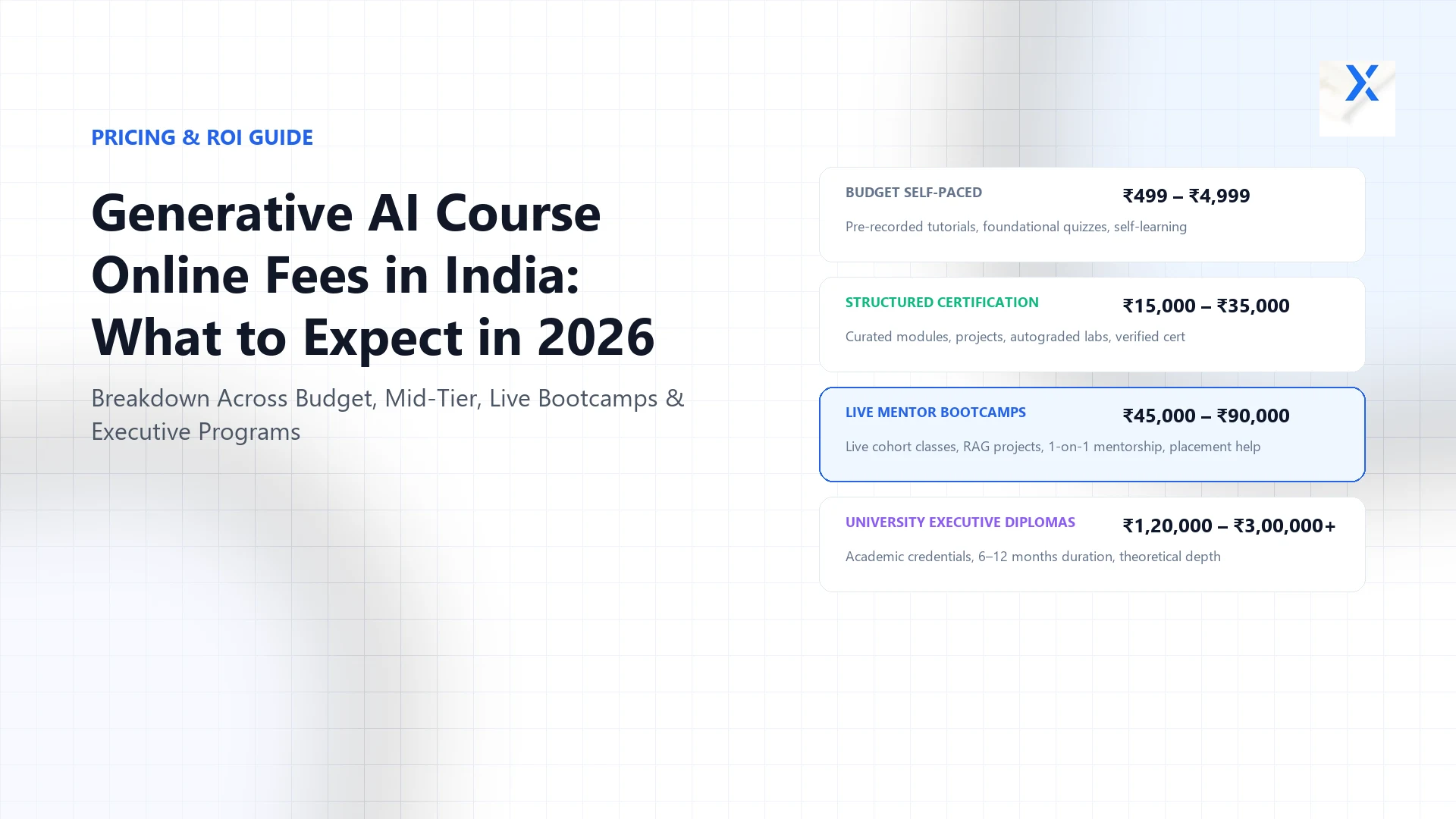
The cost of taking a generative ai online course in India varies drastically—ranging from ₹499 recorded video series to executive masterclasses costing upwards of ₹1,00,000.
You will find self-paced introductory courses on marketplaces like Udemy or Coursera, as well as comprehensive mentored programs and live cohorts from technical academies. Even when two programs claim to teach "Generative AI," their curriculum depth, level of mentor access, project grading standards, and career assistance differ fundamentally.
When comparing tuition fees, looking at the headline price alone is misleading. You must analyze what is actually included, account for cloud API costs, verify certification terms, and measure the real career return on investment.
1Typical Generative AI Course Fee Tiers in India
Self-Paced Recorded Courses
Pre-recorded video libraries (Udemy, YouTube series, low-tier subscriptions). Good for introductory prompt engineering and tool overviews without 1-on-1 human feedback.
Mentored Live Cohorts
Industry practitioner-led sessions, live code troubleshooting, verified portfolio capstones, RAG pipelines, and direct mentor Q&A (e.g., AcceleratorX programs).
University Executive Diplomas
6 to 12-month university-partnered certifications with academic credits, extended theoretical coursework, and university alumni status.
2Key Factors That Drive Course Pricing
1. Curriculum Depth & Technical Rigor
Courses covering high-level prompting cost far less to create and support than advanced engineering syllabi teaching custom RAG, vector embeddings, fine-tuning, and multi-agent systems.
2. Instructor Qualifications & Live Teaching
Programs taught by active machine learning engineers and enterprise AI leaders cost more than courses built on static recordings from general educators.
3. Project Evaluation & Human Feedback
Automated multiple-choice quizzes are free to grade. Real-world portfolio project reviews—where a mentor reviews your GitHub repo and provides line-by-line feedback—add substantial educational value.
4. Included Tool Subscriptions & API Access
Some programs supply managed sandboxes and API token credits (OpenAI, Anthropic, Hugging Face), saving you thousands in out-of-pocket development expenses.
Always inspect the complete generative AI course syllabus to ensure the curriculum justifies the tuition.
3Free vs. Paid Learning: When Is It Worth Paying?
You do not have to pay immediately. Check our guide on free vs. paid generative AI courses for an in-depth breakdown.
When Free Is Enough:
- You are testing interest in generative AI.
- You only need basic prompting for everyday emails or notes.
- You are a self-directed coder comfortable reading raw API docs.
When Paid Pays Off:
- You want a cohesive, verified step-by-step path.
- You need instructor feedback on capstone projects.
- You are upskilling for an immediate career transition or role upgrade.
- You need a verified completion certificate.
4Provider Evaluation Checklist & Comparison Table
Before registering, record each provider’s offerings across these core dimensions:
| Evaluation Criterion | What to Record & Verify |
|---|---|
| Final Total Fee | Sticker price + 18% GST + any processing charges |
| Curriculum Rigor | Whether it covers RAG, multi-agent frameworks, and vector search |
| Delivery Format | Self-paced on-demand, scheduled live cohort, or blended |
| Mentorship & Reviews | Who evaluates code and projects—automated bot or human mentor |
| API & Tool Credits | Whether LLM API usage tokens are supplied or self-funded |
| Access Period | Lifetime access vs 6-month or 1-year platform expiration |
| Refund & Deferral Terms | Money-back guarantee window and cohort deferral policies |
6Essential Questions to Ask Before Enrolling
Is the quoted fee inclusive of 18% GST?
Do you provide API keys or sandbox credits for homework assignments?
Will my capstone project be reviewed by a human instructor with written feedback?
Is the certificate included in this fee, or is there an additional assessment charge?
Can I review a sample lesson or full syllabus before making a deposit?
What is your refund policy if the course difficulty does not match my expectations?
7Frequently Asked Questions
8Conclusion & Judging True Return on Investment
Course fees in India reflect a diverse educational market. Rather than chasing the cheapest deal or assuming high prices equal superior quality, look for transparent syllabi, experienced practitioner mentorship, and practical project deliverables.
To review current transparent tuition rates, cohort schedules, and scholarship offerings for comprehensive generative AI and agent engineering training, explore AcceleratorX directly.