
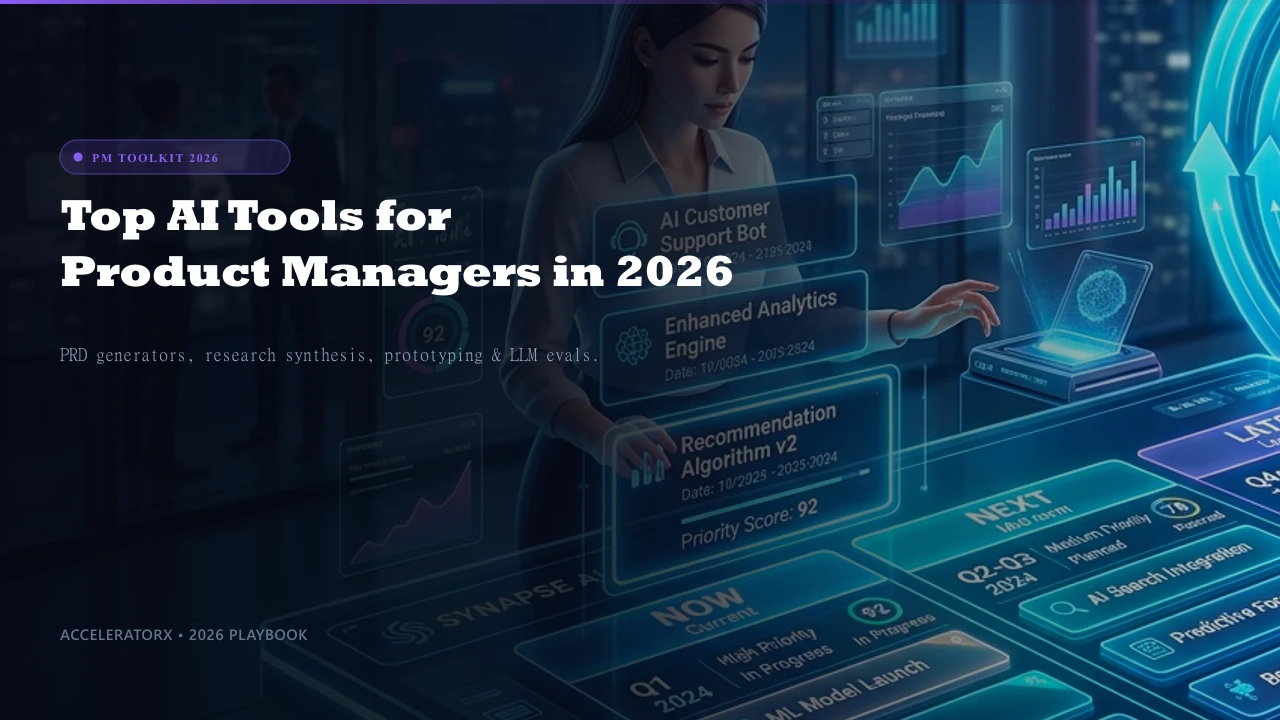
Product managers are no longer spending 15 hours a week transcribing customer interview notes, hand-writing boilerplate PRDs, or manually searching bug reports. AI-native tools have automated repetitive documentation and synthesis, freeing PMs to focus on strategic differentiation and high-stakes user discovery. Here is your curated toolkit of the best AI products shaping PM workflows.
How AI Transforms Modern PM Workflows
The essence of product management has always been synthesis: ingesting noisy signals from customers, data logs, executives, and competitive markets—and compressing them into prioritized product conviction.
Today, generative AI acts as a 10x intellectual lever across every phase of that cycle. As discussed in our AI Product Management Complete Guide, the best PMs do not use AI to abdicate judgment, but to accelerate exploration and test hypotheses rapidly.
1. Research, Discovery & Customer Feedback Synthesis
Synthesizing hundreds of support tickets, app store reviews, and Gong call transcripts used to take days. These tools automate customer voice analysis:
Best For: Automated voice-of-customer clustering. Ingests feedback from Zendesk, App Store, and surveys to surface top churn drivers, feature requests, and sentiment trends in real time.
Best For: Qualitative research synthesis. Transcribes video interviews, highlights key quotes automatically, and generates cross-study thematic summaries.
Best For: Enterprise feedback taxonomy. Maps unstructured customer feedback directly onto existing product feature hierarchies for precise backlog prioritization.
2. PRD Generation, Spec Writing & Documentation
Blank page syndrome is obsolete. AI tools now draft comprehensive Product Requirement Documents (PRDs) complete with user stories, edge cases, and acceptance criteria:
Best For: Rigorous PRD structuring, competitive tear-downs, and edge case enumeration. Claude's high context window and reasoning capabilities make it the premier choice for complex technical specs.
Best For: Purpose-built PM document drafting. Offers specialized PM templates, critiques existing specs, and uncovers missing non-functional requirements.
3. Rapid Prototyping, Wireframing & UI Generation
Validating concepts during AI Product Discovery no longer requires waiting two weeks for a designer's availability:
Best For: Generative UI design. Generates full React and Tailwind CSS components from text prompts in seconds, enabling live interactive clickable prototypes.
Best For: Auto-populating realistic prototype copy, translating designs across languages, and generating variant component layouts.
4. LLM Observability, Prompt Testing & Evals
For PMs actively managing generative AI features, these developer platforms are essential for tracking real-world model performance and preventing drift:
Best For: Full-trace LLM observability. Inspects agent execution traces, token costs, prompt latency, and automated evaluation test suites.
Best For: Open-source evaluation and drift detection. Evaluates RAG retrieval relevance, hallucination indices, and vector embedding clustering. (See our Metrics Guide).
5. Workflow Automation & Sprint Execution
AI tools streamline cross-functional alignment and sprint hygiene:
- Linear Asks & Insights: Automatically links customer requests to engineering issues and summarizes sprint bottlenecks.
- Notion AI: Instantly summarizes meeting transcripts, extracts action items, and keeps team wikis synchronized.
The AI Tool Evaluation Framework for PMs
Before rolling out an AI tool to your entire organization, evaluate it against four core criteria:
| Dimension | Evaluation Question | Red Flag |
|---|---|---|
| Data Privacy | Does the vendor train public models on uploaded enterprise data? | No zero-data-retention policy |
| Integration | Does it connect natively with Jira, Slack, GitHub, or Figma? | Requires manual copy-pasting |
| Accuracy & Evals | Can you cite sources or inspect underlying reasoning chains? | Black-box hallucinations |
Guardrails: What NOT to Delegate to AI
AI cannot feel conviction. It predicts median consensus. Distinctive, breakout product strategies come from human insight into non-consensus opportunities.
Reading AI transcripts is useful, but it cannot replace the nuance of watching a customer sigh in frustration or hesitate during an onboarding flow.
Compliance and ethical decisions can never be offloaded to machine algorithms. As detailed in our Responsible AI Guide, accountability remains strictly human.
Summary & Tool Recommendations
The modern product manager is an augmented operator. By adopting AI tools for research synthesis, PRD drafting, and LLM observability, you eliminate administrative friction and spend your energy where it matters most: understanding users, steering strategy, and driving business growth.
Complete your AI product management curriculum:
- AI Product Management: The Complete Guide →
- How to Build an AI Product Strategy and Roadmap →
- AI Product Development Lifecycle: Idea to Launch →
Learn to build PRDs with Claude, evaluate LLMs with LangSmith, and prototype interfaces with v0 in AcceleratorX's live mentorship cohorts.
Join AI PM Cohort