
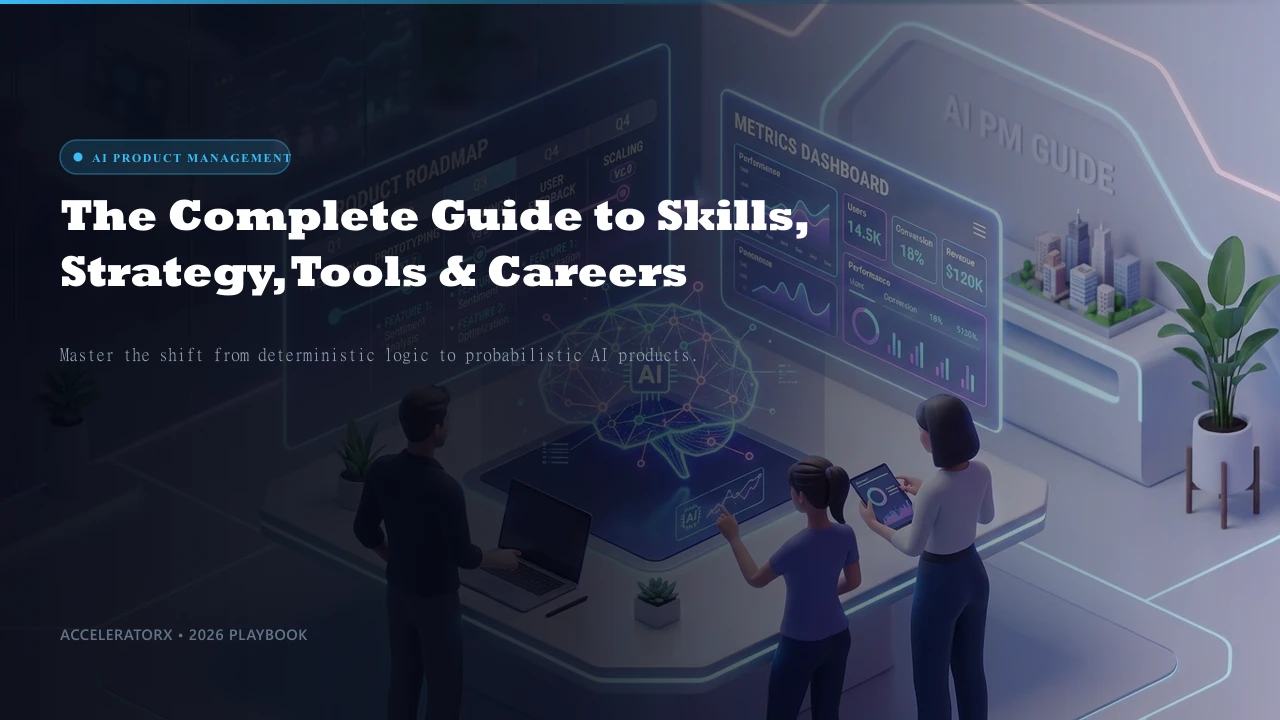
Artificial Intelligence has disrupted the core disciplines of digital product development. Today's product manager is no longer managing predictable, deterministic software pipelines; they are navigating non-deterministic machine learning models, probabilistic user experiences, foundation model APIs, and evolving ethical safeguards. This comprehensive pillar guide serves as your roadmap to mastering AI product management.
What is AI Product Management?
At its core, AI Product Management is the discipline of leading cross-functional teams to identify high-value customer problems that can be solved uniquely well by artificial intelligence, machine learning, and generative models—and delivering those solutions with commercial viability, user safety, and operational resilience.
While traditional product managers orchestrate engineering, design, and business strategy to build software with predictable rules, AI product managers must manage uncertainty at every stage. In classical software, if a user enters valid credentials and clicks “Submit”, the authentication system outputs a 100% deterministic boolean state. In contrast, an AI feature operates on probabilistic confidence scores, dynamic training distributions, and statistical approximations.
Traditional PM vs AI PM: The Shift to Probabilism
To excel in AI product management, you must unlearn several assumptions ingrained in traditional Agile software delivery. The table below highlights the operational paradigms that differentiate traditional software PMs from AI PMs:
| Dimension | Traditional Software PM | AI Product Manager |
|---|---|---|
| System Behavior | Deterministic (Code logic executes exact rules) | Probabilistic (Model outputs confidence scores) |
| Requirements Spec | Detailed PRD with fixed acceptance criteria | Data specs, threshold tradeoffs (Precision vs Recall) |
| Edge Cases | Enumerated and coded via conditional statements | Unbounded; managed via guardrails, fallback fallbacks |
| Product Lifecycle | Build → QA → Deploy → Maintain | Problem Framing → Data → Train → Eval → Monitor Drift |
| Technical Partner | Software Engineers, Frontend/Backend Architects | Data Scientists, ML Engineers, Data Annotators |
Core Competencies of Modern AI Product Managers
You do not need a Ph.D. in deep learning to be a great AI PM, but you do need sufficient technical fluency to bridge mathematical models with user empathy and business value.
Understanding model families (supervised, unsupervised, LLMs, diffusion), loss functions, false positives vs false negatives, and token latency tradeoffs.
Evaluating dataset freshness, class imbalance, annotation pipelines, and designing positive feedback loops where user usage organically improves future model iterations.
Designing interfaces for uncertainty—using confidence chips, progressive disclosure, editable AI suggestions, and transparent fallback mechanisms when confidence is low.
Proactively uncovering algorithmic bias, regulatory compliance requirements (EU AI Act, DPDP), hallucination guardrails, and copyright protections.
The End-to-End AI Product Lifecycle
Building an AI-enabled product does not follow standard two-week sprint cadences. Because machine learning is fundamentally research-driven and empirical, development requires a specialized 7-stage lifecycle:
- Problem Framing & Heuristics Check: Verifying if machine learning is truly required, or if deterministic logic/heuristics suffice.
- Data Strategy & Pipeline Engineering: Sourcing, cleaning, labeling, and validating historical and real-time datasets.
- Baseline Creation & Feasibility: Building non-ML baselines to benchmark minimal acceptable accuracy before training complex models.
- Model Experimentation & Training: Iterating on architectures, tuning prompts, fine-tuning weights, and evaluating loss curves.
- Validation & Offline Evaluation: Testing across held-out splits, stress-testing edge cases, and auditing against protected attributes.
- Deployment & Human-in-the-Loop Integration: Shipping via shadow modes, canary releases, and embedding human review triggers.
- Continuous Monitoring & Drift Detection: Tracking data drift, concept drift, hallucination rates, and latency degradation in production.
For a deep dive into each step with operational checklists and RACI matrices, read our detailed guide: The AI Product Development Lifecycle: From Idea to Launch →
AI Product Strategy & Defensible Flywheels
Simply wrapper-coating an existing LLM API does not create long-term enterprise value. True AI product strategy centers on defensibility—often rooted in proprietary workflow integration, proprietary proprietary feedback datasets, or custom user context.
When building your strategy, evaluate initiatives along four critical dimensions:
- Customer Impact: Does this eliminate a critical workflow bottleneck or enable net-new capabilities?
- Data Advantage: Do we own or have unique access to the training and evaluation signals needed to succeed?
- Feasibility & Latency Cost: Can the model run fast enough and cheap enough to maintain unit economics at scale?
- Operational Risk: What is the business downside when (not if) the model generates an incorrect prediction?
Learn how to formulate weighted prioritization matrices and outcomes-based roadmaps in our companion guide: How to Build an AI Product Strategy and Roadmap →
Problem Discovery & Validation for AI Features
The cardinal sin of AI product management is technology looking for a problem. Effective discovery means rigorously validating whether a problem space actually benefits from statistical inference.
High-leverage discovery techniques for AI include:
- Wizard of Oz Testing: Simulating AI behavior with human operators behind the scenes before spending months training models.
- Prompt Prototyping: Rapidly testing edge cases and prompt variations in playground environments to establish user tolerance boundaries.
- Threshold Discovery: Interviewing customers to pinpoint the exact precision vs recall balance they will tolerate (e.g., is missing a true alert worse than receiving false alarms?).
Explore our discovery playbook and validation case studies: AI Product Discovery: Finding and Validating the Right Problems to Solve →
Measuring Success: Model Performance vs Business KPIs
Data scientists celebrate achieving a 95% F1-score or decreasing perplexity. As an AI Product Manager, your job is to translate those statistical figures into revenue, retention, customer trust, and operational efficiency.
The AI Balanced Scorecard:
A robust AI product measurement framework tracks Model Performance (ROC-AUC, Precision, BLEU), Business Value (Conversion, Time-Saved, LTV), User Trust (Override Rate, Edit Distance, NPS), and Engineering Efficiency (Inference Cost per Query, P99 Latency).
Master how to align data science metrics with boardroom objectives in our guide: AI Product Metrics and KPIs: Measuring Success Beyond Model Accuracy →
Responsible AI, Bias, and Ethical Guardrails
AI failures can cause immediate reputational, financial, and legal harm. Responsible AI is not an afterthought or compliance checklist; it is an architectural pillar of product resilience.
Core responsibilities include:
- Auditing training sets for historical and representation bias.
- Implementing semantic guardrails to prevent toxic output or unauthorized prompt injection.
- Designing human-in-the-loop escalation paths for high-stakes decisions (e.g., credit, hiring, healthcare).
- Complying with international regulatory standards such as the EU AI Act and India’s DPDP Act.
Read the complete ethical framework and crisis management guide: Responsible AI Product Management: Ethics, Bias, and Governance →
The Essential AI Product Manager Toolkit
Just as AI is changing the products we build, it has fundamentally transformed the PM’s daily workflow. From synthesizing thousands of customer reviews with conversational clustering to building automated PRD drafts and evaluating LLM outputs with observability tools, today's PM toolkit is heavily augmented.
Key tool categories include:
- LLM Observability & Evals: LangSmith, Arize Phoenix, Helicone, Weights & Biases.
- Discovery & User Research Synthesis: Kraftful, Dovetail, Enterpret.
- Rapid Prototyping & Wireframing: v0 by Vercel, Lovable, Claude Artifacts.
Discover the complete curated software stack for PMs: Top AI Tools for Product Managers in 2026: Work Smarter, Not Harder →
Career Paths & Transition Strategies
Demand for professionals who can translate cutting-edge AI research into scalable commercial software has surged across tech hubs in India and globally. Roles range from Associate AI Product Manager (APM) to Director of AI Products and VP of Product (AI Platform).
How do you transition into AI Product Management?
- From Traditional PM: Lead an AI-driven initiative in your current company (e.g. search personalization, customer support deflection, workflow automation) to build verified case studies.
- From Data Science / ML Engineering: Deepen your customer empathy, business acumen, and cross-functional communication skills. Focus on the "why" and "what" rather than solely the "how".
- From Software Engineering / Consulting: Build end-to-end AI applications using modern APIs, document your product trade-offs publicly, and build a verified portfolio.
Summary & Next Steps
The era of speculative AI hype has given way to rigorous product execution. The PMs who succeed over the next decade will be those who master the delicate balance between cutting-edge model capabilities, human-centered product experience, unit economics, and responsible governance.
Dive into the individual guides across our AI Product Management cluster to elevate your product leadership:
- 1. AI Product Development Lifecycle: From Idea to Launch
- 2. How to Build an AI Product Strategy and Roadmap
- 3. AI Product Discovery: Finding and Validating the Right Problems to Solve
- 4. AI Product Metrics and KPIs: Measuring Success Beyond Model Accuracy
- 5. Responsible AI Product Management: Ethics, Bias, and Governance
- 6. Top AI Tools for Product Managers in 2026: Work Smarter, Not Harder
Master AI product strategy, machine learning fundamentals, agile product roadmapping, and ethical AI frameworks with live mentorship at AcceleratorX.
Explore AI Product Management Course