
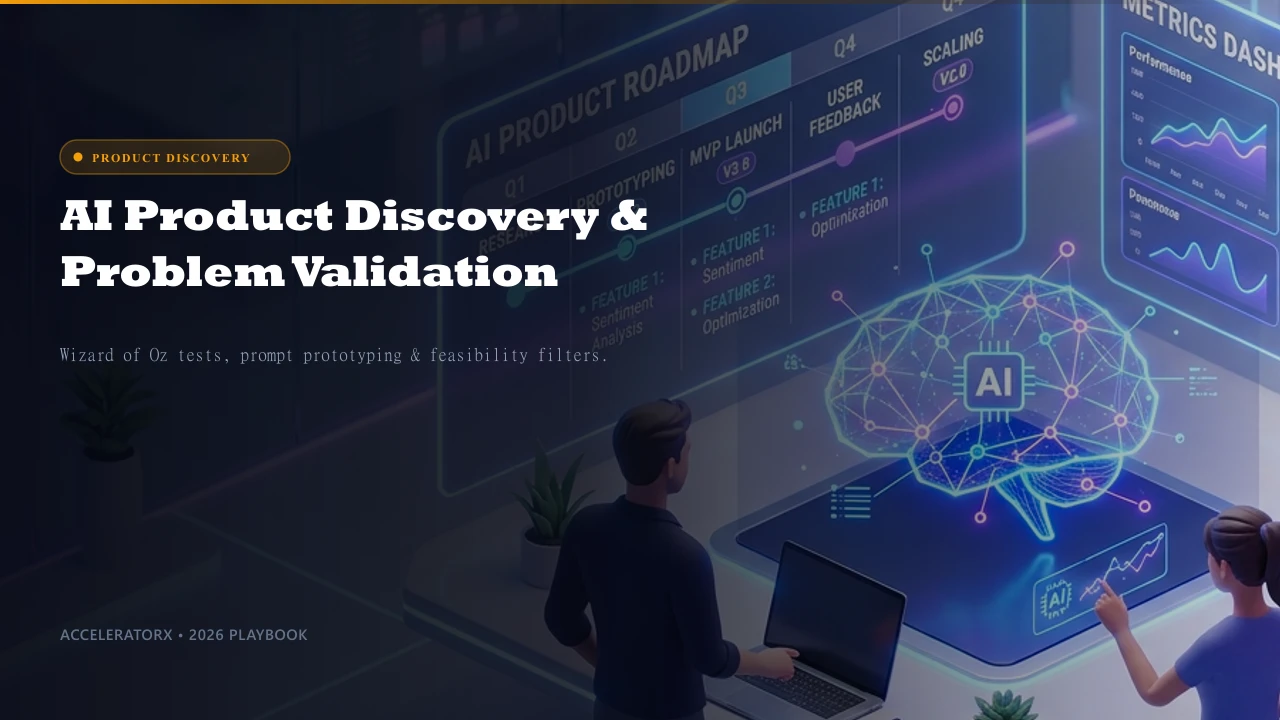
The biggest reason AI features flop in production is not poor model accuracy—it is solving the wrong problem, or solving a problem that users never wanted automated in the first place. AI product discovery requires specialized validation tools to de-risk user willingness, interface trust, and data viability before investing thousands of engineering hours.
What Makes AI Product Discovery Unique?
In traditional discovery, product teams validate desirability (do users want this?) and viability (will they pay for it?). In AI product discovery, two additional risks must be rigorously de-risked upfront:
- Probabilistic Tolerance Risk: How tolerant is the user of imperfect or incorrect answers? If an AI recommendation engine suggests a sub-optimal movie, the user shrugs. If an AI accounting tool miscalculates payroll by 3%, the company faces tax penalties.
- Data Viability Risk: Does the organization possess or have permission to access the historical ground truth required to train and evaluate a model?
As outlined in our Pillar Guide to AI Product Management, successful discovery separates real customer pain from superficial AI hype.
Step 1: Identifying High-Leverage AI Problem Spaces
Not every business process benefits from artificial intelligence. The best AI product managers look for problem spaces possessing three hallmark traits:
Workflows where humans spend hours reading unstructured text, categorizing tickets, summarizing reports, or extracting data points manually.
Surfaces where static rules cannot scale: personalized product feeds, dynamic pricing, contextual search queries, and customized coaching plans.
Processes that require ingesting voice, video, images, or PDFs to generate synthesized outputs that software logic cannot handle with regex.
Step 2: The 4 Feasibility Filters (Value, Usability, Data, Tech)
Before drafting a technical specification or opening a Jira epic, run every candidate feature through four sequential filters:
Will users perceive substantial value even if the feature requires human review or manual edits? Does the time saved exceed the time spent inspecting model output?
Can the user interface elegantly present probabilistic outputs? Can users easily override, undo, or correct the AI without breaking their flow?
Do we have access to labeled samples? What is the signal-to-noise ratio in the current data pipeline? Are there legal restrictions on using this data for training?
Can we satisfy inference latency constraints (<200ms)? Will token compute expenses remain within unit economic margins at 100k daily active users?
Step 3: Low-Fidelity AI Prototyping (Wizard of Oz & Prompts)
Do not build machine learning models to test if users want AI assistance. Build rapid low-fidelity simulations:
- Wizard of Oz Testing: Create an interface where users trigger an "AI Smart Action", but behind the scenes, a human product manager or support agent processes the request in real time. This tests whether users find the output valuable before any ML code is written.
- Prompt Sandboxing: Utilize tools like Anthropic Console, OpenAI Playground, or LM Studio to feed 50 varied real customer inputs into foundation models. Observe where the system breaks, where hallucinations emerge, and what system prompt rules are needed.
- Paper / Wireframe Stress Testing: Present users with mockups displaying incorrect AI suggestions. Observe their reaction: Do they easily detect the mistake? Does it cause frustration or cognitive load?
Step 4: Defining Acceptance Criteria for Probabilistic Features
In traditional user stories, acceptance criteria are binary: "Given a valid email, when user clicks signup, verify email is sent."
In AI product management, acceptance criteria must specify statistical thresholds and error tolerances:
Sample AI Acceptance Criteria:
- • Precision Threshold: Model must achieve ≥ 92% precision on priority category routing.
- • Fallback Trigger: If confidence score < 0.75, automatically route to general queue with zero AI automation badge.
- • Latency Ceiling: P95 inference latency must remain under 350ms under peak concurrent traffic.
- • User Correction Telemetry: Every user manual override must be logged as a negative training sample within 24 hours.
To explore how to measure these criteria in production dashboards, read our AI Product Metrics & KPIs Guide.
Case Study: Validating an AI Smart Support Routing Engine
Consider a B2B SaaS platform receiving 25,000 customer tickets monthly. Management wanted to deploy an automated AI agent to autonomously reply to and resolve incoming inquiries.
Instead of greenlighting a 6-month autonomous agent project, the AI PM applied our 4-step discovery framework:
- Data Audit: Audited 2,000 historical tickets and found that 45% were complex debugging questions requiring access to private customer databases that the model could not safely access without compliance risk.
- Wizard of Oz Simulation: Simulated automated responses for 100 beta customers. Customers were dissatisfied when the bot answered generic troubleshooting steps for urgent billing questions.
- Pivot to Smart Classification: Instead of autonomous replies, the PM pivoted to intelligent routing and priority tagging. The model categorized tickets and routed billing questions directly to senior human reps within 60 seconds.
- Outcome: Ticket first-response time dropped by 54%, human agent satisfaction increased by 38%, and zero hallucination risks were introduced.
Discovery Summary & Next Steps
AI product discovery is the art of balancing technological curiosity with ruthless user empathy. By validating data availability, simulating user reactions before writing code, and codifying statistical acceptance criteria, you shield your organization from costly AI misadventures.
Continue exploring the AI product management lifecycle:
- The AI Product Development Lifecycle: From Idea to Launch →
- Top AI Tools for Product Managers in 2026 →
- Responsible AI: Ethics, Bias & Governance →
Learn to run Wizard of Oz experiments, design prompt testbenches, and frame AI feasibility with veteran product managers at AcceleratorX.
Explore Product Management Course