
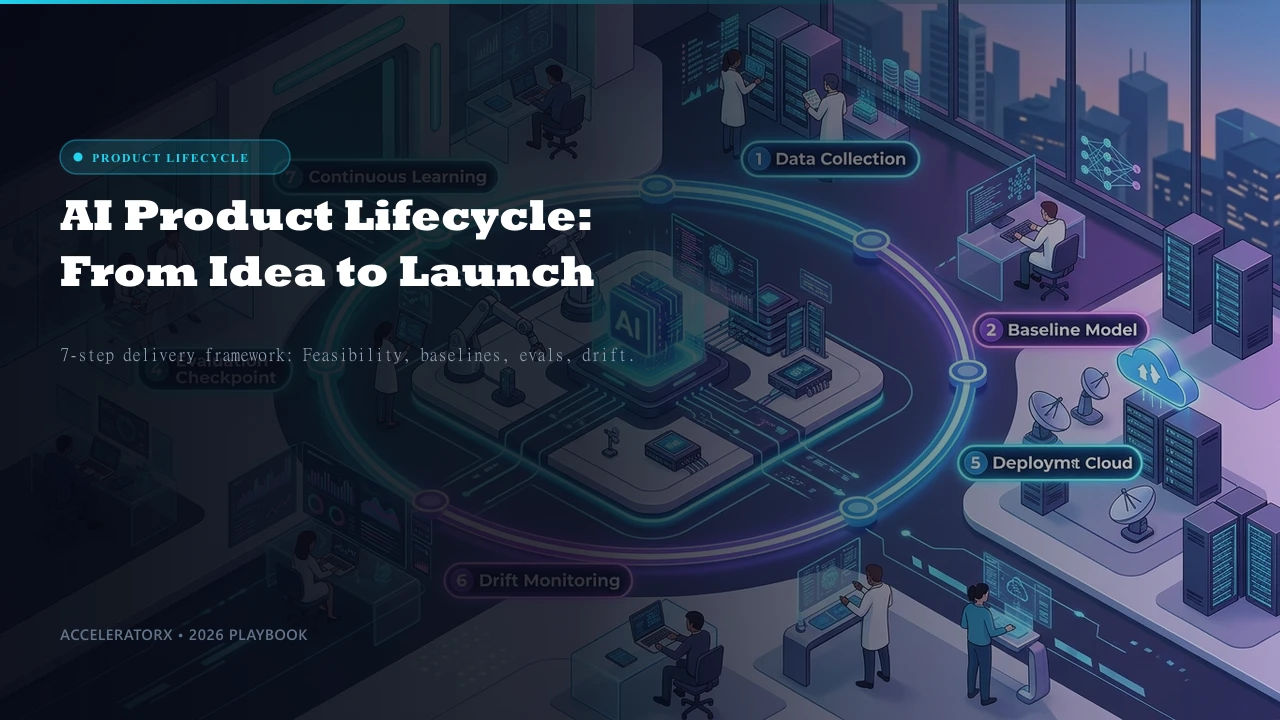
Building artificial intelligence products requires abandoning the illusion of linear software roadmaps. Machine learning is fundamentally experimental: models depend on real-world data distributions that evolve, degrade, and surprise. This guide breaks down the 7 phases of the modern AI product development lifecycle, complete with actionable checkpoints and cross-functional RACI responsibilities.
Why the AI Lifecycle Is Fundamentally Different
In standard software development, engineering is deterministic. If your requirements state: "When an enterprise customer clicks upgrade, invoice their card and update their account tier," your developers write the business logic, write unit tests, and the code functions exactly as prescribed.
In AI product development, outcomes are probabilistic. If your requirement states: "Identify fraudulent transactions with 98% precision without delaying checkout," no engineer can guarantee that threshold until data is audited, models are trained, and inference latency is profiled.
As covered in our AI Product Management Complete Guide, this experimental reality demands a cyclical, data-centric delivery framework.
Stage 1: Problem Definition & Feasibility Assessment
Every successful AI product starts by interrogating whether machine learning is actually necessary. The best AI product managers treat AI as an expensive, complex tool of last resort, not a default starting point.
The Three Feasibility Gates
- Business Feasibility: Does solving this problem with probabilistic accuracy deliver exponential ROI compared to deterministic heuristics or simple rules?
- Data Feasibility: Do we currently possess the historical data, feature signals, and labeling capacity required to train a model? Is the data clean, unbiased, and compliant with privacy regulations?
- Technical & Latency Feasibility: Can our infrastructure run inference within acceptable latency budgets (e.g. <150ms for synchronous user interfaces)? What will token or GPU compute costs look like at peak volume?
Stage 2: Data Strategy & Pipeline Engineering
In traditional development, code is the primary asset. In AI, data is the program. The quality, volume, and balance of your training corpus directly dictates the ceiling of model performance.
Key responsibilities during this phase include:
- Data Auditing & Exploration: Analyzing class distributions, missing fields, temporal bias, and data leakage.
- Annotation Strategy: Determining whether to utilize internal subject-matter experts, crowdsourced labeling (e.g., Scale AI, Labelbox), or synthetic data generation with foundation models.
- Data Flywheel Architecture: Ensuring that every user interaction in production captures implicit or explicit feedback (thumbs up/down, edits, overrides) to systematically enrich future training splits.
Stage 3: Model Exploration & Baseline Creation
Before training multi-billion parameter neural networks or fine-tuning open-weights models, an AI PM must establish a simple baseline. A baseline provides the benchmark against which complex AI investments are judged.
The Rule of Simple Baselines
Always build a heuristic or simple linear regression baseline first. If a rule-based algorithm achieves 84% accuracy in 2 days of work, spending $80,000 and 3 months to train a deep neural net that achieves 87% may represent a negative return on capital.
Stage 4: Model Development & Experimentation
During this iterative research phase, data scientists and ML engineers test architectures, loss functions, and hyperparameters. For teams building on Generative AI, this phase involves prompt engineering, Retrieval-Augmented Generation (RAG) indexing, and model distillation.
The AI PM's role during model development is not to tweak learning rates, but to maintain tight alignment with user tolerance thresholds. When engineers encounter precision-recall tradeoffs, the PM decides whether false positives or false negatives are costlier to user trust.
Stage 5: Evaluation, Validation & Bias Auditing
Offline accuracy on a training test split rarely reflects real-world performance. In Stage 5, the model is subjected to rigorous offline stress testing across multiple dimensions:
- Slicing & Subgroup Analysis: Does the model perform equally well across different user cohorts, languages, geographies, and demographics?
- Adversarial & Red-Teaming Tests: How easily can the model be tricked, jailbroken, or induced to hallucinate harmful content?
- Ethical & Bias Auditing: Verifying compliance with fairness criteria, as outlined in our Responsible AI Product Management Playbook.
Stage 6: Deployment, Shadow Releases & Integration
Shipping an AI model directly to 100% of user traffic is hazardous. High-performing AI teams deploy through graduated release rings:
- Shadow Deployment (Dark Launch): The model runs in production alongside live user requests and generates predictions, but outputs are logged silently rather than shown to users. This tests inference latency, throughput, and real data behavior safely.
- Canary Release: Routing 2% to 5% of traffic to the model while closely tracking error rates, exception budgets, and latency spikes.
- Human-in-the-Loop Assist: Surfacing model predictions as suggestions to human agents or internal operators before exposing fully automated actions to external consumers.
Stage 7: Monitoring, Drift Detection & Feedback Loops
Software doesn't rot, but AI models decay constantly. When external user behavior shifts, seasonality occurs, or consumer terminology evolves, model predictions degrade—a phenomenon known as drift.
The distribution of incoming production inputs changes over time relative to the distribution of the training data (e.g. new slang or new device categories).
The statistical relationship between the inputs and target labels shifts entirely (e.g., consumer purchasing patterns shifting during an economic crisis).
For actionable strategies on tracking drift and holistic success criteria, refer to our comprehensive guide on AI Product Metrics and KPIs: Measuring Success Beyond Model Accuracy.
Cross-Functional Collaboration: The AI RACI Matrix
Because AI involves specialized disciplines, clear division of ownership is essential to prevent finger-pointing between data science, engineering, and product.
| Lifecycle Phase | AI PM | Data Science | ML / Software Eng | Product Design |
|---|---|---|---|---|
| Problem & Feasibility | Accountable | Consulted | Consulted | Responsible |
| Data Sourcing & Specs | Responsible | Accountable | Responsible | Informed |
| Model Training & Tuning | Informed / Tradeoffs | Accountable | Responsible | Informed |
| Eval & Threshold Tuning | Accountable | Responsible | Consulted | Consulted |
| Production Monitoring | Consulted | Responsible | Accountable | Informed |
Common Pitfalls Across the AI Lifecycle
Treating deployment as the finish line. AI products require persistent operational budgets for retraining, annotation auditing, and drift mitigation throughout their lifecycle.
Rushing to custom fine-tune foundation models before testing few-shot prompting or RAG architectures. Fine-tuning introduces severe maintenance burdens and model obsolescence.
Assuming users will forgive 5% errors. If an error destroys user workflow progress or exposes confidential enterprise data, the product will be uninstalled regardless of accuracy scores.
Key Takeaways & Next Steps
Navigating the AI product development lifecycle requires embracing continuous iteration. By establishing strict feasibility gates, building humble baselines, staging phased deployments, and setting up automated drift alarms, you position your AI initiatives for long-term production success.
Continue exploring the strategic dimensions of product leadership:
- How to Build an AI Product Strategy and Roadmap →
- AI Product Discovery: Finding & Validating Problems →
- Top AI Tools for Product Managers in 2026 →
Learn to frame AI problems, manage data scientists, run shadow deployments, and monitor production drift with top product leaders.
Enroll in the AI PM Program