
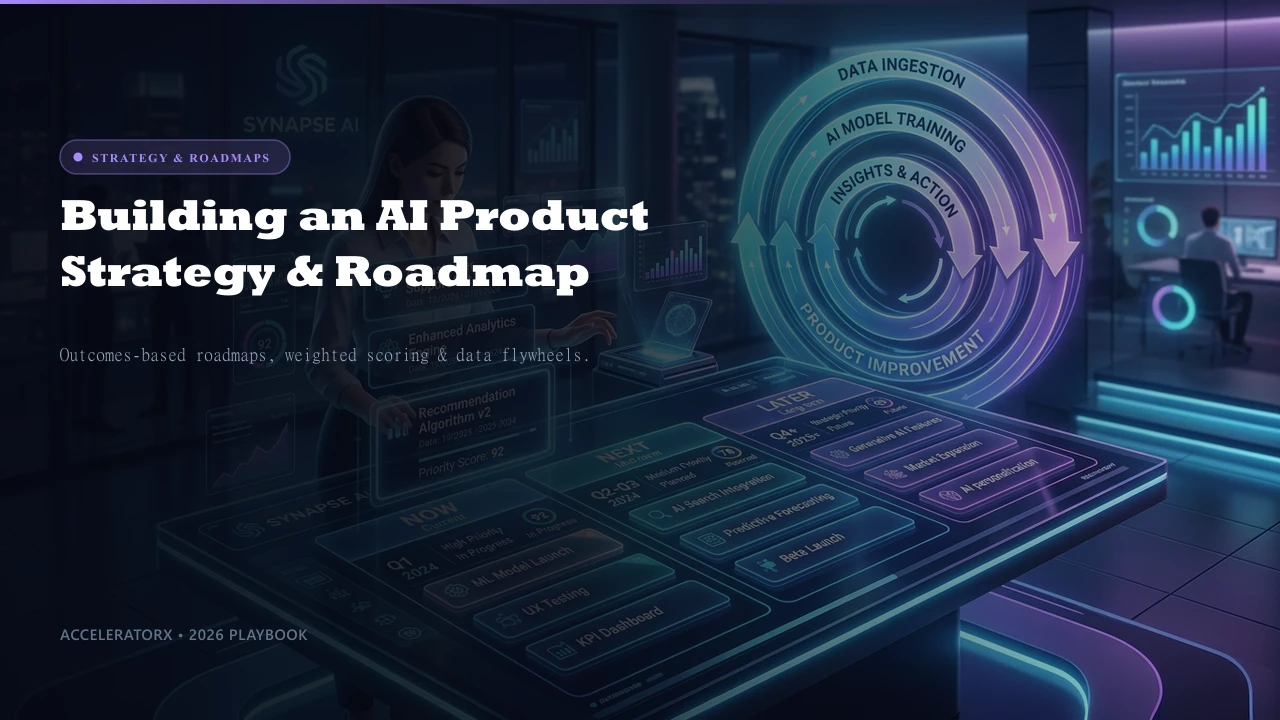
Too many enterprise AI roadmaps resemble feature wishlists wrapped around third-party model APIs. When commodity models are accessible to every competitor via identical API calls, your sustainable competitive advantage comes from data flywheels, proprietary workflow context, and outcomes-driven planning. Here is how to construct a resilient AI product strategy.
Why Traditional Product Roadmaps Fail for AI
Classical product roadmaps rely on time-bound Gantt charts: "In Q2 we ship feature X, in Q3 we ship feature Y." This framework assumes that development effort correlates directly with feature readiness.
In artificial intelligence, this assumption collapses. An ML engineering squad can spend eight weeks training, pruning, and evaluating models only to discover that the training distribution lacks signal, yielding an unacceptable 61% accuracy. Conversely, a breakthrough in zero-shot prompting might solve in two afternoons a problem originally budgeted for three sprints.
Treating AI development as predictable feature delivery sets up teams for missed deadlines and disgruntled stakeholders. As detailed in our AI Product Development Lifecycle guide, AI roadmaps must be organized around learning milestones and outcome thresholds rather than rigid calendar deliverables.
The 4 Pillars of an AI Product Strategy
An actionable AI product strategy balances customer value with technological defensibility across four structural pillars:
Does the AI feature create 10x workflow acceleration (superpowering existing users) or unlock net-new capability that was previously impossible? Avoid decorative AI features that add friction without delivering clear utility.
Does your product architecture create a virtuous cycle? More users → more interaction telemetry → richer proprietary fine-tuning data → superior model accuracy → increased customer retention. Without a data flywheel, any competitor can replicate your features overnight.
Can the solution scale sustainably? Assess inference token costs, latency budgets, hardware availability, and maintenance overhead before greenlighting ambitious architectures.
Embedding fairness, data privacy, and compliance checks (such as the EU AI Act) into initial roadmaps prevents catastrophic post-launch rework. See our Responsible AI framework.
Framework: Prioritizing AI Initiatives with Weighted Scoring
Standard prioritization models like RICE or WSJF often fail when applied to AI because they lack explicit factors for data readiness and model failure risks. We recommend a customized AI Opportunity Scoring Matrix:
| Initiative | User Impact (35%) | Data Readiness (25%) | Tech Feasibility (20%) | Risk & Downside (20%) | Priority Score |
|---|---|---|---|---|---|
| AI Ticket Auto-Classification | 8 / 10 | 9 / 10 | 9 / 10 | 8 / 10 (Low risk) | 8.45 (Tier 1 - Now) |
| Smart Summary Generator | 7 / 10 | 7 / 10 | 8 / 10 | 6 / 10 (Hallucination risk) | 7.00 (Tier 2 - Next) |
| Autonomous Financial Advisory | 9 / 10 | 4 / 10 | 3 / 10 | 2 / 10 (High liability) | 5.15 (Tier 3 - Later) |
Structuring an Outcomes-Based AI Roadmap (Now / Next / Later)
Instead of promising exact release dates six quarters in advance, organize your team around a Now / Next / Later thematic structure:
Features with verified data availability and proven offline performance. Focus: deployment, UX polish, latency optimization, and initial canary rollouts.
Features undergoing data collection audits, baseline modeling, and prompt engineering. Focus: validating user demand and achieving minimum accuracy thresholds.
Ambitious bets requiring brand new datasets, major research breakthroughs, or evolving regulatory approvals. Focus: tracking academic research and data pipeline seeding.
Managing Stakeholder Expectations with Probabilistic Milestones
Executive stakeholders and enterprise clients are accustomed to binary software deliverables. When an AI feature launches, they may expect 100% perfection. Educating stakeholders early is critical to managing reputations and budget approvals:
- Communicate in Confidence Intervals: Replace "This feature will automate 90% of requests by July" with "Our model targets an 80% to 92% resolution rate with a human review fallback."
- Establish Failure Cost Budgets: Agree upfront on what constitutes an acceptable error rate and what safety buffers exist when the model makes mistakes.
- Report on Business Impact Rather Than Raw Loss: Translate technical benchmarks into cost savings, response time reductions, or revenue lift using frameworks from our AI Product Metrics and KPIs Guide.
Strategic Summary & Next Steps
A great AI product strategy doesn't start with models; it starts with proprietary problem insight, defensible data architecture, and clear human value. By shifting from deterministic Gantt charts to probabilistic outcomes roadmaps, product managers can drive transformative innovation while keeping engineering realistic.
Continue your AI product leadership journey:
- AI Product Discovery: Finding & Validating Problems →
- AI Product Metrics and KPIs: Measuring Success →
- AI Product Management Complete Guide →
Learn how to evaluate AI business cases, structure outcomes-based roadmaps, and negotiate unit economics in AcceleratorX's live mentorship cohorts.
Explore the AI PM Program