
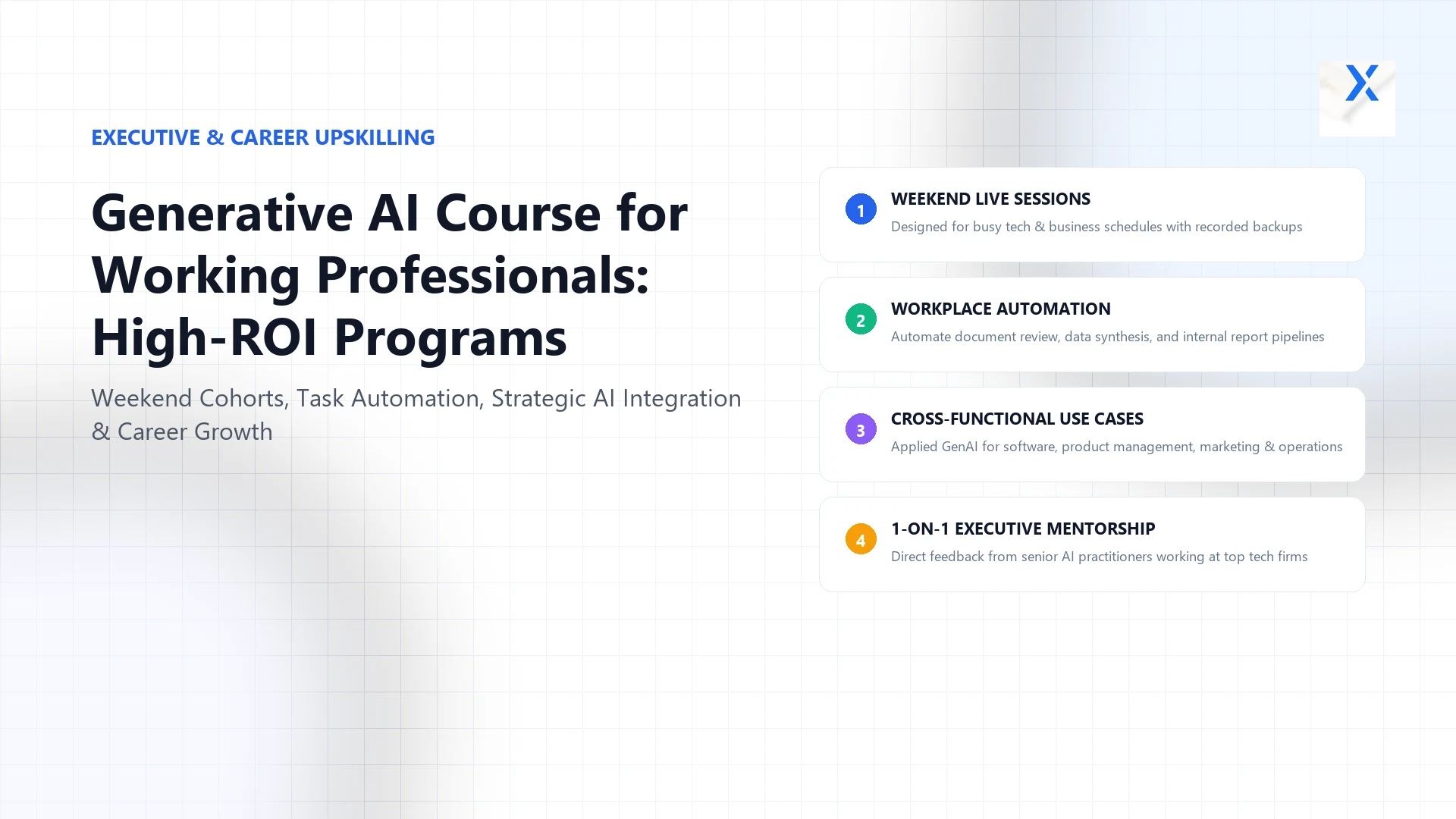
Working professionals face a unique challenge: they must acquire cutting-edge artificial intelligence capabilities while managing demanding full-time jobs, deliverables, and personal commitments.
When selecting a generative ai online course, working professionals must look beyond theoretical overviews. A busy practitioner does not need 40 hours of abstract linear algebra; they need actionable frameworks to automate repetitive data parsing, streamline market research, accelerate software delivery, or architect reliable enterprise AI prototypes.
This guide walks you through selecting a course aligned with your specific functional role, balancing your weekly calendar, protecting sensitive enterprise data, and measuring learning through tangible workplace artifacts.
1Define Role-Specific Learning Goals
Rather than taking a generic "overview" course, choose training tailored to your day-to-day domain:
Product Managers
Synthesizing customer discovery interviews, generating structured PRDs, prioritizing roadmaps, and evaluating AI feature feasibility.
Marketing & Growth
Drafting multi-channel copy, automating competitive intelligence briefs, optimizing SEO metadata, and analyzing ad performance.
Data & Business Analysts
Automating SQL query generation, writing Python scripts for messy data transformation, and drafting executive summaries.
Operations & HR
Standardizing operating procedures (SOPs), automating policy FAQ retrieval, and routing customer tickets.
Software Engineers
Building LLM APIs, implementing vector embeddings, fine-tuning retrieval algorithms, and deploying autonomous agents.
Executive Leaders
Formulating enterprise AI strategy, auditing compliance & data governance, evaluating vendor solutions, and calculating ROI.
2Choosing the Right Technical Depth (No-Code vs. Code)
Do not pay for advanced engineering content if your immediate mandate is workflow optimization. Match the course depth to your day-to-day responsibilities:
No-Code / Applied Track
Ideal for business leaders, marketers, PMs, and consultants.
- Advanced prompt engineering & system instructions
- Commercial tool comparison (ChatGPT, Claude, Perplexity)
- Automated workflows with Zapier/Make and webhooks
- Reviewing AI outputs for bias, accuracy, and brand alignment
Engineering & Architecture Track
Ideal for software engineers, data scientists, and technical architects.
- OpenAI, Anthropic, and local model APIs (Ollama)
- Vector databases (Pinecone, Chroma, pgvector)
- Retrieval-Augmented Generation (RAG) pipelines
- Agent orchestration frameworks (LangGraph, CrewAI)
Check our detailed breakdown of the complete generative AI course syllabus for module-by-module comparisons.
3Evaluating Course Formats for Busy Schedules
Review our guide on self-paced vs. live generative AI courses to analyze scheduling trade-offs:
Self-Paced Learning
Offers maximum flexibility when work travel or unpredictable deadlines make fixed meetings impossible. Requires high self-discipline to prevent procrastination.
Weekend Live Cohorts
Scheduled on Saturday/Sunday mornings to avoid weekday workday interference. Provides direct access to instructors, instant feedback, and peer networking.
Hybrid / Blended Formats (Recommended)
Watch pre-recorded video lectures during lunch or commutes, and attend live weekend office hours for code reviews and capstone feedback.
4Practical 4-Block Weekly Study Schedule
Attempting to study for 4 consecutive hours on a weekday evening leads to cognitive exhaustion. Instead, distribute your learning across 4 manageable weekly blocks:
| Weekly Study Block | Duration | Focus Activity |
|---|---|---|
| Block 1: Theory & Concept | 60–90 mins (Tue Eve) | Watch core concept modules on one specific topic (e.g., Vector chunking). |
| Block 2: Tool Practice | 60 mins (Thu Eve) | Run the provided sandbox notebook or test prompts in an AI playground. |
| Block 3: Practical Application | 120 mins (Sat Morning) | Apply the technique to a synthetic workplace challenge or mock case study. |
| Block 4: Review & Reflection | 45 mins (Sun Eve) | Review outputs for errors, note questions for mentor office hours, and document limitations. |
5What a Professional AI Course Must Include
Focus on Model Shortcomings: Explaining context windows, hallucinations, and why automated outputs require guardrails.
Systematic Output Verification: Frameworks to empirically test output factuality, precision, and latency.
Transferable Workflows: Teaching durable prompting principles rather than transient hacks for a single UI.
Portfolio Capstone Projects: Requiring students to build complete, working solutions.
Enterprise Compliance Guidance: Strict rules on data sanitization, privacy terms, and zero-retention API policies.
Experienced Practitioner Mentors: Instructors who actively deploy AI systems in enterprise environments.
Review our complete list of generative AI projects to build after your course.
6Measuring ROI Through Practical Work Samples
Do not measure your progress by course completion percentage bars. Measure your ROI by building reusable workplace assets:
3-Point Work Sample Documentation Format:
- The Operational Challenge: Summarize the manual task (e.g., spending 6 hours weekly manually categorizing user feedback tickets).
- The AI Workflow Solution: Describe the prompt chain, model tier, and verification rules used to automate ticket clustering.
- Measured Business Results & Guardrails: Note the accuracy rate (e.g., 94% alignment with human tagging) and the human-in-the-loop escalation criteria for low-confidence tickets.
7Data Privacy & Enterprise Compliance
Never input proprietary corporate roadmaps, customer Personally Identifiable Information (PII), or unreleased financial data into public commercial AI chatbots. Always practice using synthetic, open-source, or non-confidential sample datasets. Verify whether your employer has enterprise API agreements with explicit zero-data-retention guarantees before processing company assets.
8Frequently Asked Questions
9Conclusion & Selecting the Right Program
The best generative ai online course for working professionals is one that respects your calendar, provides verified credentials, connects directly to your job deliverables, and emphasizes repeatable engineering frameworks over hype.
If you are ready for a flexible, weekend-friendly cohort with industry practitioner mentorship, real project code reviews, and enterprise credentialing, evaluate AcceleratorX’s current cohort schedule.