
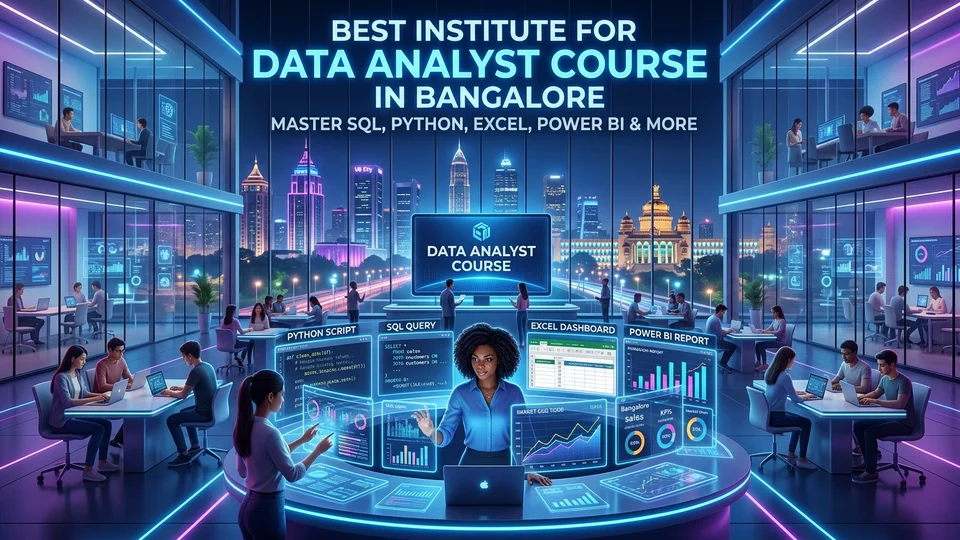
Data analyst course fees in Bangalore vary by course length, delivery mode, curriculum, trainer experience, included projects, certification, and career services. As a rough guide, basic data analyst courses in Bangalore start from around INR 10k to INR 30k. More comprehensive courses, which cover a range of tools and include career and project support, can range from INR 40k to INR 1,00k and above. Some courses offer an introduction to one or two tools; others are more comprehensive and cover Excel, SQL, Python, Power BI, statistics, business case studies, and portfolio development.
When looking at data analyst course fees in Bangalore, consider the total cost, not just the lowest advertised price. The registration fees, exam fees, certification fees, software fees, fees for any advanced modules and placement services may not all be included in the initial price.
This guide covers what affects the cost of data analytics courses, what services may be bundled in, how to compare pricing structures, and what questions to ask before you pay. To make your comparison process as straightforward as possible, we've outlined the key steps you should take: ask for a written breakdown of the fees, compare the curriculum and the number of training hours, check what level of support and project guidance is provided, and check what the certification is and what the career and placement services are. These steps will help you structure your comparison and ultimately choose the right course for your needs.
What are the data analyst course fees in Bangalore?
There is no one fee for every data analyst course in Bangalore. Prices vary by provider because courses differ in scope, duration, delivery mode, and the range of services included.
A basic course may focus on Excel, SQL, or Power BI, while a broader programme may include:
- Excel for data analysis
- SQL and database querying
- Python programming
- Power BI or Tableau
- Statistics
- Data cleaning
- Data visualisation
- Business case studies
- Portfolio projects
- Resume preparation
- Mock interviews
- Placement assistance
Published course prices and promotional discounts are subject to change. Always request a written fee quotation directly from the training provider before enrolling.
What determines the cost of data analytics courses in Bangalore?
Several things can influence the end cost of a data analytics programme.
Course Duration
Short intro courses cover fewer concepts, while longer courses provide more in-depth training across a range of tools.
Course formats can include:
- Short-term introductory training
- Individual software modules
- Comprehensive data analytics programmes
- Weekend courses
- Fast-track programmes
- Self-paced courses
- Instructor-led online training
- Classroom training
A longer course doesn't necessarily mean it's of better quality. You need to ask whether that extra time is actually spent on meaningful practice, assignments, trainer feedback, projects and the like. If you're a complete beginner, it's often far more valuable to focus on the practical bits and get responsive feedback from your trainer than to go down the route of the longest course.
Tools and Curriculum
The number and depth of tools available will affect the price of data analytics courses in Bangalore.
A basic programme may cover spreadsheet analysis, while a more extensive curriculum could include:
- Advanced Excel
- SQL
- Python
- Pandas
- Power BI
- Tableau
- Statistics
- Data storytelling
- Business analytics
- AI-assisted analytics tools
Don't judge a course solely on the number of software names it throws in its advert. Look at how much time it allocates to each piece of software and how much practical training it provides.
Online, Classroom, or Hybrid Training
The delivery format will affect both the course fee and your overall learning cost.
| Live online | Remote access, flexible location, reduced travel | Internet, computer, software |
|---|---|---|
| Self-paced online | Flexible schedule and repeatable lessons | Limited live trainer access |
| Classroom | Face-to-face interaction and structured attendance | Travel, food, and accommodation |
| Hybrid | Combination of online convenience and classroom support | Travel plus technology requirements |
Online courses may well cut down on your travel costs, but you'll still need a computer, a good internet connection and any necessary software.
Trainer Experience
Programmes delivered by experienced instructors or industry professionals will of course have a different pricing structure to fully recorded or fully automated courses.
Before paying a higher price based on trainer claims, ask:
- Who will the tutors be?
- What actual analytics experience do they have?
- Are trainer profiles available?
- Will the advertised trainer actually teach your batch?
- Can the learners ask questions during the sessions?
- Will trainers review the assignments themselves?
- Is individual mentoring included?
A demo class will, of course, enable you to assess the trainer's teaching style.
Live Classes and Recorded Lessons
Live instructor-led sessions can be more expensive than recorded, self-paced sessions because they involve scheduled interaction and doubt clearing.
Confirm whether the fee includes:
- Live classes
- Recorded sessions
- Repeat access to lessons.
- Doubt-clearing sessions
- Revision classes
- Individual mentoring
- Batch transfers
- Extended platform access
Don't assume that recordings or lifetime access are included unless the provider explicitly states this in writing.
Projects and Practical Assignments
Projects can add value to the programme if they use real data, have a clear structure, and include trainer feedback.
Ask whether the course provides:
- Guided assignments
- Individual projects
- Group projects
- Business case studies
- Project reviews
- Portfolio guidance
- Presentation practice
- Independent capstone projects
Projects should be about your analysis, not the end chart or dashboard.
Certification and Assessments
Some courses include a completion certificate in the main fee. Others may charge separately for exams, retakes, or external certifications.
Before enrolling, confirm:
- Who issues the certificate?
- Is it a completion certificate or an external certification?
- Are assessments compulsory?
- Are examination fees included?
- Are retake charges applicable?
- Can the certificate be checked?
- Does the certificate expire?
- Is third-party registration required?
A course completion certificate should not be automatically assumed to be accredited or industry recognised. You need to check the issuing body and the qualification's actual status.
Career and Placement Support
Some programmes include career preparation; others are purely technical.
Career services may include:
- Resume reviews
- LinkedIn profile guidance
- Mock interviews
- Technical interview preparation
- Aptitude training
- Portfolio reviews
- Job alerts
- Application assistance
- Candidate profile sharing
- Interview coordination
Placement assistance doesn't guarantee you a job. You need the details in writing on what the service actually entails, who is eligible, and how long the assistance will be provided. Placement figures for data analyst courses in Bangalore generally fall in the 70-90% range for eligible candidates (again, this will vary from provider to provider and from candidate to candidate). Typical roles include Junior Data Analyst, Data Analyst, Business Analyst, Reporting Analyst, and MIS Executive. Actual outcomes vary by provider, but these are the typical roles and placement rates you can expect. Please check with the individual provider for the most up-to-date placement stats and actual outcomes.
Data Analyst Course Fee Structure in Bangalore
A transparent data analyst course fee structure in Bangalore should clearly itemise training costs and any optional or additional charges.
| Tuition fee | Subjects, tools, sessions, and training hours included |
|---|---|
| Registration fee | Whether it is refundable or included in the total |
| Taxes | Whether the advertised fee includes applicable taxes |
| Learning materials | Availability of recordings, datasets, exercises, and notes |
| Software access | Whether licences or subscriptions are included |
| Assessments | Number of tests, projects, and evaluation attempts |
| Certification | Whether certificate and examination charges are included |
| Project guidance | Number of reviews and mentoring sessions |
| Career services | Resume, interview, and application support provided |
| Instalment charges | Interest, processing fees, and payment deadlines |
| Retake charges | Cost of repeating exams, modules, or classes |
| Cancellation charges | Deductions and refund eligibility |
Request this in writing so you can compare providers on an apples-to-apples basis.
How to Compare Data Analytics Course Costs in Bangalore
When comparing data analytics course costs in Bangalore, calculate the total amount you'll have to pay.
Request a Written Fee Breakdown
Ask each provider to separate:
- Tuition fees
- Registration charges
- Taxes
- Examination fees
- Certification charges
- Software costs
- Learning materials
- Project mentoring
- Career services
- Instalment charges
- Optional advanced modules
A lower advertised fee may in fact exclude the services which are included in the total price of another programme.
Compare the Curriculum
Check that the course actually teaches the skills that are relevant to your aims.
A comprehensive syllabus may include:
- Excel
- SQL
- Python
- Power BI
- Tableau
- Statistics
- Data cleaning
- Data visualisation
- Business problem-solving
- Portfolio projects
Also look at the depth of coverage. A course that gives you a brief introduction to ten tools is probably of less practical value than one that teaches a smaller number of tools in some depth.
Calculate the Cost per Training Hour
Ask how many hours of instructor-led training are included in the fee. Distinguish between live teaching hours and recorded content, assignments, and independent project work.
Cost per training hour shouldn't be the only deciding factor, but it can help distinguish between similar programmes.
Evaluate Project Support
Find out whether the trainers will review the projects and provide individual feedback.
Confirm:
- How many projects are there?
- Are the projects guided or independent?
- Are realistic datasets provided?
- How many review sessions are there?
- Can learners add projects to a portfolio?
- Will the learners present their findings?
- Is capstone mentoring included?
A programme that provides meaningful project feedback may be better value than one that merely provides project files for download.
Review Career Services
If career support is part of the fee, then ask what it actually covers.
Possible services include:
- Resume preparation
- LinkedIn optimisation
- Mock interviews
- SQL and Excel assessments
- Portfolio reviews
- Job alerts
- Interview coordination
- Application guidance
Ask if career services are available to all learners or only to those who meet certain eligibility criteria.
Understand Access Duration
Check how long you can use the learning platform and course materials.
Ask whether the fee includes:
- Temporary access
- Access until course completion
- Extended access after completion
- Downloadable resources
- Recorded class access
- Future content updates
- Revision batches
Don't assume that "lifetime access" means you get live support, you get updated content, or you get future classes.
Is an affordable Data Analyst course in Bangalore worth it?
An affordable data analyst course in Bangalore can be a good deal if it actually teaches you the skills you need and gives you sufficient scope to practise them.
A lower-cost course may be suitable when it provides:
- A clear beginner-friendly curriculum
- Practical exercises
- Relevant tools
- Trainer support
- Project assignments
- Transparent fees
- Suitable learning materials
However, choosing a course purely because it's the cheapest may leave gaps in your learning.
Potential limitations can include:
- Limited SQL practice
- Recorded lessons without live support
- No assignment feedback
- Outdated software demonstrations
- Few business case studies
- No independent projects
- Additional certification charges
- Restricted platform access
Before you pay, review the sample lessons, trainer profiles, course policies, project examples, and learner support options.
The aim is to choose the right training within your budget, not just the cheapest course on offer.
Online Versus Classroom Data Analyst Course Fees
Online and classroom courses can have different direct and indirect costs.
Online Course Cost Considerations
An online programme may involve:
- Course tuition
- Internet expenses
- Computer or hardware requirements
- Software subscriptions
- Examination charges
- Certification fees
- Optional mentoring
Online training can cut travel costs and offer far greater scheduling flexibility.
Classroom Course Cost Considerations
A classroom programme may involve:
- Course tuition
- Registration fees
- Daily travel
- Food expenses
- Accommodation, if applicable
- Printed learning materials
- Missed work or study time
- Examination charges
Learners should consider the total cost of participation, not just the tuition fee.
Are EMI and Instalment options available?
Some training providers will offer EMI, instalment plans or third-party finance. Availability and the terms of such arrangements will vary according to the provider and the finance partner.
Before selecting an instalment option, confirm:
- The total amount payable.
- The number of instalments
- Interest charges
- Processing fees
- Payment dates
- Late payment penalties
- Cancellation terms
- Refund eligibility
- Automatic payment conditions
- Whether payments continue after withdrawal
A smaller monthly instalment doesn't imply a lower total cost. Compare the total amount payable under the finance arrangement with the standard course fee.
What should a data analytics course fee include?
Services will vary, but a well-designed programme might include the following.
Technical Training
The course may cover:
- Excel
- SQL
- Python
- Power BI or Tableau
- Statistics
- Data visualisation
- Business problem-solving
Confirm the number of sessions and the level of coverage for each topic.
Learning Materials
Course fees may include:
- Class recordings
- Practice datasets
- Exercises
- Reference notes
- Quizzes
- Case studies
- Project files
- Revision resources
Check the access period and whether you can download the materials.
Trainer Support
Trainer support may include:
- Live doubt resolution
- Assignment reviews
- Project feedback
- One-to-one mentoring
- Revision sessions
- Technical support
Ask if there is a cap on the number of support sessions.
Assessments
Assessments may include:
- Module tests
- Practical exercises
- Tool-based assignments
- Business case studies
- Final projects
- Presentations
Are assessments, retakes and evaluations all included in the main fee?
Certification
Find out if a completion certificate is included and what the learner's requirements are.
Certification conditions may involve:
- Minimum attendance
- Passing assessments
- Submitting assignments
- Completing projects
- Paying examination fees
Career Services
Career services can cover resume reviews, mock interviews, portfolio advice, job alerts and application assistance.
Confirm that these services are either included or available as an optional paid package.
Skills You Should Expect to Learn
A full data analytics programme might cover the following areas.
Excel for Data Analysis
Learners may study:
- Formulas and functions
- Lookup functions
- Data cleaning
- Pivot tables
- Charts
- Business reporting
- Basic dashboards
SQL for Database Queries
SQL training may include:
- SELECT statements
- Filtering
- Sorting
- Aggregate functions
- GROUP BY
- Joins
- Subqueries
- Common table expressions
Python for Analytics
Python topics may include:
- Programming fundamentals
- NumPy
- Pandas
- Data manipulation
- Exploratory analysis
- Matplotlib
- Seaborn
- Basic automation
Power BI and Visualisation
Power BI training may cover:
- Power Query
- Data transformation
- Table relationships
- Data modelling
- DAX fundamentals
- Visualisations
- Interactive dashboards
Statistics
Statistics topics may include:
- Mean, median, and mode
- Percentages
- Probability fundamentals
- Distributions
- Standard deviation
- Correlation
- Regression fundamentals
Business Projects
Learners may apply their skills to:
- Sales analysis
- Customer behaviour
- Marketing performance
- Inventory management
- Financial reporting
- Operational performance
The exact syllabus will vary depending on the programme you select. When shortlisting data analytics course providers in Bangalore, look for institutes with a strong industry reputation and positive word of mouth from alumni. Check student reviews on independent sites, on LinkedIn, and in various forums. Consider placement records, trainer experience, past student results, and whether the institute is a member of any major industry bodies. That will help you identify the right provider and make a sound decision.
Should you choose the complete course or individual modules?
The right option depends on your current skill level and learning objectives.
Individual Modules May Suit You If:
- You already understand analytics fundamentals.
- You need training in one specific tool.
- You have a limited budget.
- You want to close a particular skill gap.
- You prefer a shorter learning commitment.
A Comprehensive Programme May Suit You If:
- You are a complete beginner.
- You want a structured learning sequence.
- You need training across multiple tools.
- You want project guidance.
- You need career preparation.
- You prefer one combined programme.
Compare the cost of the individual modules against the total cost of the full programme.
Related Data Analytics Learning Resources
Learners considering remote training can review the guide to better understand the various course formats and features of the learning experience.
The guide explains how AI can be incorporated into analytics training.
You can also review the guide to learn about the tools used in modern analytical workflows.
These resources can help you identify the subjects and course features to compare before enrolment.
Questions to Ask Before Paying Your Course Fees
Ask the training provider the following questions:
- What's the full course fee?
- Does the published price include tax?
- Are registration charges separate?
- Which tools and topics are covered?
- How many live training hours are there?
- Are recorded lessons included?
- How long will I have access to the materials?
- How many practical projects will I complete?
- Will the trainers review my assignments and projects?
- Are the exam and certification fees included?
- Who issues the certificate?
- Is software access included?
- Are resume and interview services included?
- What does placement assistance entail?
- Are there any instalment or EMI options?
- What is the total amount payable via EMI?
- Are there any further or optional charges?
- What are the cancellation and refund terms?
Request written answers so you can properly compare the various programmes. Be very mindful of any hidden costs which may not be reflected in the published fee. Typical examples include software subscriptions, exam retake fees, certification fees, registration fees, taxes, costs for printed materials, and any additional charges for extended platform access or access to advanced modules. Ask each provider for a full breakdown of all possible additional costs so you can compare them properly.
Make an Informed Course Investment
Data analyst course fees in Bangalore depend on the curriculum, duration, teaching format, projects, certification, trainer involvement, and career support.
Before enrolling:
- Compare the complete fee structure.
- Confirm all additional charges.
- Review the depth of the curriculum.
- Evaluate trainer and project support.
- Understand certification requirements
- Check career service conditions.
- Read the refund policy.
- Calculate the total EMI cost, if applicable.
An affordable programme can provide good value when its syllabus, teaching approach, practical training, and learner support match your requirements.
to compare relevant skills, tools, and learning formats before choosing a training programme.
Frequently Asked Questions
What are the data analyst course fees in Bangalore?
Data analyst course fees in Bangalore vary by course length, delivery mode, curriculum, trainer support, projects, certification, and career services offered. You'll need to request the current pricing and a full written breakdown of fees from each provider.
Why do the fees for data analytics courses differ?
Fees vary because courses offer different levels of tools, training hours, delivery formats, projects, certificates, mentoring, and career services. Some of the advertised prices may also be pre-tax or may not include additional charges.
Are online data analytics courses cheaper than classroom courses?
Online courses can reduce travel and accommodation costs, but tuition fees vary by provider and the range of services they offer. Compare the total cost of learning rather than assume one delivery mode is cheaper.
What's in the data analyst course fees?
Course fees may cover training, recorded lessons, datasets, assignments, projects, assessments, certificates, trainer support and career services. Check what's included, as inclusions can vary by provider.
Are the certification fees included in the course price?
Some courses include certification in the tuition fee; others charge separately for exams, retakes, and external credentials. Get written confirmation from the provider.
Is a cheap data analytics course worth it?
A cheap course can be a good deal if it has a relevant curriculum, practical work, good trainer support and clear pricing. Assess the course quality rather than choosing the cheapest option.
Do data analytics institutes offer EMI options?
Some providers will offer instalments (EMI), or third-party financing. Check the total amount payable, interest, processing charges, payment due dates, and cancellation terms.
Are placement services included in the data analytics course fees?
Placement/career services may be included, optional or available only to eligible learners. Check whether the programme offers resume reviews, mock interviews, job alerts, application support and interview coordination.
Do I need to pay separately for analytics software?
Software access policies vary. Some analytics tools offer free or limited versions, while certain subscriptions may cost extra. Confirm whether required software is included in the course fee.
Which tools should a data analytics course include?
A comprehensive beginner programme may include Excel, SQL, Python, Power BI, statistics, data visualisation, and practical projects. The right combination depends on your learning objectives and target roles.
Is a longer data analytics course better?
Not necessarily. A longer course is valuable only when the additional time includes relevant instruction, practical exercises, project feedback, and useful topics.
Should I pay the complete course fee in advance?
Review the provider’s terms, refund policy, course schedule, and written commitments before paying in full. If instalments are offered, compare their total cost and conditions.
Related Data Analytics Resources
Become a Certified Data Analyst in Bangalore
Master Excel, SQL, Python, Power BI & Generative AI with hands-on projects and 1:1 career placement assistance.