
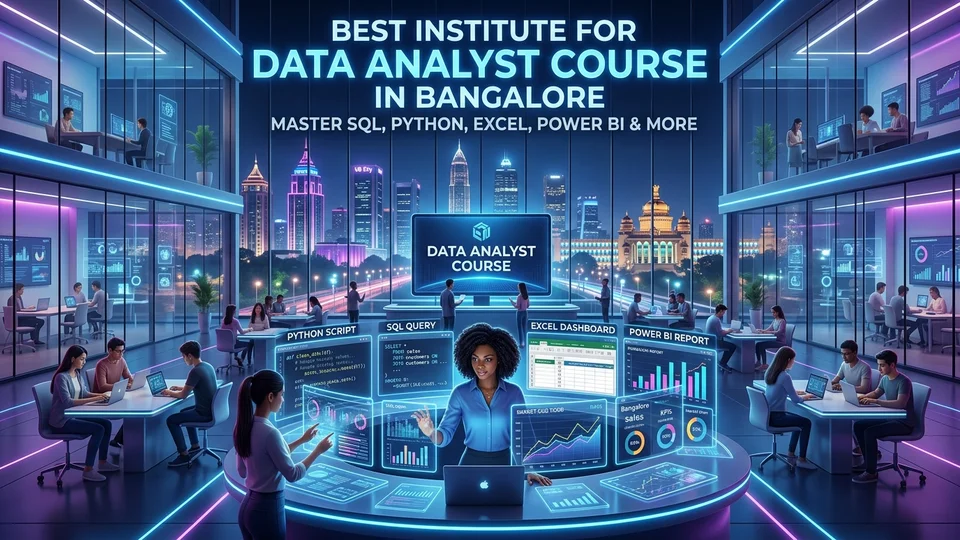
The ideal institute for a data analyst course in Bangalore will offer a complete curriculum, experienced trainers, hands-on projects, flexible modes of study, clear and transparent fees, recognised course completion certificates, and a solid career guidance programme.
However, no one institute is the be-all and end-all for every learner. A fresher, a working professional, and a career changer will have very different needs. The right training provider suits your current skill level, availability, budget, preferred learning style, and career goals.
Before you enrol, compare the syllabus, teaching methodology, projects, trainer profiles, assessments, certificate details, placement policy and the total course fees. To help you decide, follow a step-by-step comparison process.
- Shortlist the institutions based on your initial research and preferences.
- Check the course details directly with each provider (curriculum, trainer profiles, project work, career services, etc.).
- Where possible, attend a demo class or a sample session to get a feel for their teaching style and the level of support they provide.
- Look at the feedback from the more recent learners and clear up any questions you may have with the admissions team.
- Make your final decision based on which institution best fits your own needs, objectives and expectations.
This guide explains how to assess data analytics institutes in Bangalore objectively.
How do you choose the best data analytics institute in Bangalore?
Pick a data analytics institute by comparing the curriculum, trainer experience, practical work, project feedback, mode of delivery, student support, cost, certification and career services.
A reliable comparison should answer these questions:
- Does the course match your current experience level?
- Does it cover Excel, SQL, Python, Power BI, and statistics?
- Does the programme have any practical elements?
- Will the trainers review your projects?
- Do you offer live classes, recordings, and doubt-clearing sessions?
- Are the full fees made absolutely clear?
- Who issues the certificate?
- What does placement assistance entail?
- Do written terms back up placement claims?
- Do the recent reviews include specific, verifiable details?
Don't pick an institute based on rankings, advertising, ratings, placement %, location, or placement % in any advertising. Be wary of the usual suspects: dodgy or inflated placement claims, hidden/unclear fees, uncertainty as to who will issue the certificate, lack of information on the trainer, lack of detail on the project feedback, generic reviews and so on. If an institute avoids answering your questions or promises placement without written terms, that's a red flag.
What makes a data analytics institute a good choice?
A good institute will help learners understand analytical concepts and apply them to real business problems.
Important selection criteria include:
- A structured and current curriculum
- Beginner-friendly instruction
- Experienced trainers
- Hands-on exercises
- Realistic business projects
- Individual feedback
- Flexible learning options
- Transparent course fees
- Clear certificate information
- Verifiable career services
An institute's reputation can help, but it shouldn't be the only factor in your choice.
Comprehensive Data Analytics Curriculum
A good curriculum should cover the full analytics lifecycle: data collection and cleaning, analysis, visualisation and communication of the results.
The syllabus may include:
- Microsoft Excel
- SQL
- Python
- Power BI or Tableau
- Statistics
- Data cleaning
- Data visualisation
- Exploratory data analysis
- Business problem-solving
- Dashboard development
- Data storytelling
- Portfolio projects
Compare the depth of instruction, not the number of tools listed in a brochure.
A course which gives a very broad introduction to several applications may in fact be of less practical value than a course which focuses on a small number of tools and teaches them in depth via a series of exercises and projects.
Excel for Data Analysis
Microsoft Excel is used extensively to organise information, do calculations, clean data, and produce business reports.
An employment-focused Excel syllabus may include:
- Formulas and functions
- IF statements
- VLOOKUP and XLOOKUP
- INDEX-MATCH
- Sorting and filtering
- Conditional formatting
- Data validation
- Pivot tables
- Pivot charts
- Data-cleaning techniques
- Basic dashboards
Learners should practise answering business questions using sales, customer, inventory, finance, and operations data.
SQL and Database Queries
Structured Query Language (SQL) is the language analysts use to pull and examine data from relational databases.
SQL training may cover:
- SELECT statements
- WHERE conditions
- Sorting
- Aggregate functions
- GROUP BY
- HAVING
- Table joins
- Subqueries
- Common table expressions
- Window functions
- Database fundamentals
Learners should write the queries themselves rather than just using pre-prepared solutions.
Python for Data Analytics
Python can be used for data cleaning, automation, exploratory analysis, and visualisation.
A practical Python curriculum may include:
- Programming fundamentals
- Variables and data types
- Conditional statements
- Loops and functions
- NumPy
- Pandas
- Data manipulation
- Exploratory data analysis
- Matplotlib
- Seaborn
- Basic automation
Beginner-level courses should explain the code's logic rather than having learners copy a complex piece of code without understanding it.
Power BI and Data Visualisation
Power BI enables analysts to turn raw data into reports and interactive dashboards.
Power BI training may include:
- Importing datasets
- Power Query
- Data transformation
- Data relationships
- Data modelling
- DAX fundamentals
- Charts and visualisations
- Filters and slicers
- Dashboard design
- Report publishing
Learners should also understand how to choose the right visualisations and explain the business meaning of the dashboard results.
Statistics and Analytical Thinking
Stats help the analyst to interpret the data properly and avoid drawing any conclusions that aren't supported by the data.
Relevant topics may include:
- Mean, median, and mode
- Percentages and ratios
- Range and standard deviation
- Data distributions
- Probability fundamentals
- Sampling
- Correlation
- Hypothesis testing
- Regression fundamentals
- Identifying outliers
The course should focus on statistical concepts and how they apply in the real world, rather than just presenting formulae.
Business Communication and Data Storytelling
A data analyst must communicate findings to both technical and non-technical stakeholders.
A suitable programme should teach learners how to:
- Define a business question.
- Select relevant information
- Explain the analytical method.
- Present the main findings.
- Describe limitations
- Avoid unsupported claims
- Recommend evidence-based actions
- Design clear reports and presentations.
Technical skills are only really valuable when the learner can explain how their analysis leads to a business decision.
Experienced Data Analytics Trainers
Trainer experience can affect how well technical concepts and business applications are explained.
Before joining an institute, ask:
- Who will teach the course?
- What level of analytics experience do the trainers have?
- Have they done any practical projects?
- Are their profiles public?
- Will the advertised trainer actually teach your batch?
- Can learners ask questions in class?
- Will trainers review assignments?
- Is individual mentoring available?
- Can you come to a demo class?
A good trainer should be able to explain how the tool works, when to use it, why a particular approach is appropriate, and its limitations.
Don't just go on job titles or the number of years stated in the promotional material. Go to a demo and see whether the trainer can explain the concepts clearly.
Hands-On Assignments and Projects
Practical projects let learners apply their technical skills to real business problems.
Relevant project topics may include:
- Sales performance analysis
- Customer segmentation
- Marketing campaign analysis
- Inventory reporting
- Financial dashboards
- Employee attrition analysis
- E-commerce performance
- Supply chain analysis
- Customer retention
- Operational reporting
A well-structured project should include:
- A clearly defined problem
- A realistic dataset
- Data-cleaning steps
- The tools and methods used
- Visualisations
- Findings
- Limitations
- Evidence-based recommendations
Ask whether the trainers go through each project and give specific feedback. If you're completing projects without feedback, it's hard to know where you've made an error in the analysis.
Portfolio Development
Freshers and those changing careers may have very limited experience in professional analytics. A portfolio can be the best form of evidence of practical ability.
A balanced beginner portfolio could include:
- An Excel sales analysis
- An SQL customer-order project
- A Power BI performance dashboard
- A Python data-cleaning project
The course should enable the learner to document the objective, the process, the tools, the findings and the limitations of each project.
Learners should be able to explain every portfolio project. They should not be relying on memorised descriptions.
Flexible Learning Options
Data analytics institutes in Bangalore may provide:
- Classroom training
- Live online classes
- Self-paced recorded lessons
- Hybrid learning
- Weekday batches
- Evening classes
- Weekend batches
- Fast-track programmes
The ideal learning format lets you attend regularly, practise regularly, complete assignments, and ask questions as and when you need to.
Classroom Training
Classroom learning is probably best for learners who prefer face-to-face learning and a fixed timetable.
When selecting this format, consider:
- Institute location
- Travel time
- Class schedule
- Batch size
- Access to trainers
- Availability of recordings
- Missed-class policies
Live Online Training
Live online courses may be ideal for those who need flexibility or don't want to travel every day.
Confirm whether the programme provides:
- Live instructor interaction
- Session recordings
- Doubt-clearing support
- Project reviews
- Technical assistance
- Platform access after completion
Self-Paced Learning
Recorded programmes can offer scheduling flexibility, but they don't necessarily provide much direct support.
Check whether self-paced learners receive:
- Mentor access
- Assignment feedback
- Project evaluation
- Discussion forums
- Updated materials
- Career services
How to Compare Data Analytics Institutes in Bangalore
Use the same criteria for each provider so that your comparison is as objective as possible.
| Curriculum | Tools, concepts, depth, and relevance to your goals |
|---|---|
| Trainers | Experience, teaching ability, and availability |
| Practical training | Exercises, assignments, datasets, and case studies |
| Projects | Number, quality, reviews, and portfolio suitability |
| Learning format | Classroom, live online, recorded, or hybrid |
| Batch size | Opportunities for interaction and individual support |
| Course duration | Live hours, practice time, and project requirements |
| Certificate | Issuing organisation and completion requirements |
| Fees | Tuition, taxes, exams, software, and additional charges |
| Career support | Resume, interviews, job alerts, and eligibility terms |
| Reviews | Recent, detailed, and relevant learner experiences |
| Policies | Refunds, cancellations, batch transfers, and missed classes |
Create a shortlist only once you've checked all of that directly with each of the institutions.
How important are reviews and ratings?
Reviews can be a useful source of information on teaching quality, course organisation, projects, student support, and career services.
However, a high rating alone doesn't mean the course is right for you.
When evaluating reviews:
- Read both positive and critical feedback.
- Focus on recent reviews.
- Look for detailed descriptions.
- Check whether the review names the relevant course.
- Compare comments across multiple platforms.
- Look for recurring strengths or complaints.
- Be cautious of vague or repetitive wording.
- Consider whether the reviewer completed the programme.
Comments on trainer feedback, practical assignments, how doubts were addressed, and the course's overall organisation can be more useful than general kudos.
Wherever possible, talk to former learners who have gone through the same programme. Find out what they actually learned, how their projects were assessed, and whether the support they were promised matched what they experienced.
A successful learner's result doesn't necessarily translate to the same outcome for every individual student.
Typical job outcomes after a data analytics course include roles like Data Analyst, Business Analyst, Reporting Analyst, and Junior Data Scientist. Entry-level salaries in Bangalore generally range from INR 3 to 6 lakhs per annum, depending on your degree, technical skills, project portfolio, and the organisation you're joining. Many freshers start in an analyst or reporting role, and people coming from a career change can often use their existing domain knowledge to move into a Business Analyst or Subject Matter Expert role. Of course, the actual jobs and pay will vary based on your profile, and you will need to keep up with the learning curve to progress in your career.
Which institute is best for Data Analytics in Bangalore?
There's no single answer, as learners' objectives, experience, available time, and budgets will differ.
Best Choice for Freshers
Freshers may benefit from:
- Beginner-friendly instruction
- Foundational Excel and statistics
- Step-by-step SQL training
- Guided Python exercises
- Portfolio projects
- Resume preparation
- Mock interviews
Best Choice for Working Professionals
Working professionals may prioritise:
- Weekend or evening classes
- Live online access
- Recorded sessions
- Advanced SQL
- Dashboard development
- Projects connected to their industry
Best Choice for Career Changers
Career changers may need:
- A structured learning roadmap
- Beginner-level technical instruction
- Transferable business projects
- Portfolio guidance
- Interview preparation
- Support explaining previous experience
Best Choice for Existing Analysts
Learners with previous analytics experience may prefer:
- Advanced SQL
- Python automation
- Data modelling
- DAX
- Advanced visualisation
- AI-assisted analytics
- Specialised projects
The best programme targets your actual skill gaps rather than filling you with content you don't need to pay for.
Choosing an Institute by Location in Bangalore
Learners may search for data analytics institutes in areas such as:
- BTM Layout
- Indiranagar
- Koramangala
- Marathahalli
- Whitefield
- Jayanagar
- Electronic City
- HSR Layout
- Rajajinagar
- Hebbal
Location can affect travel time, attendance, and the overall cost of learning. It shouldn't replace a good curriculum, experienced trainers, or project support.
If you're looking for the best data analytics training institute in BTM Layout, Indiranagar or any other part of Bangalore, do the comparison:
- Travel time
- Class schedules
- Batch size
- Trainer availability
- Classroom facilities
- Online backup classes
- Missed-session policies
- Course fees
- Projects
- Career support
An institute further away may still be the better option if it provides live online attendance or recorded sessions. When choosing, focus on curriculum quality, trainer quality,r and the level of support offered rather than location. Location matters, but a good institute with good support may well be worth the journey (or the online option) if it's a significant distance away.
Data Analytics Course Fees and Additional Costs
Course fees can depend on:
- Programme duration
- Number of tools covered
- Training format
- Trainer involvement
- Projects
- Certification
- Mentoring
- Career services
Request a complete written fee breakdown covering:
- Tuition fees
- Registration charges
- Taxes
- Learning materials
- Software subscriptions
- Examination fees
- Certification charges
- Project mentoring
- Career services
- Instalment charges
- Retake fees
A lower advertised price may in fact exclude the services which are included in the total cost of another programme.
Don't assume that recordings, certificates, placement support or lifetime access are included without written confirmation.
Course Certificate and Assessments
Before enrolling, ask:
- Who issues the certificate?
- Is it a completion certificate or an external certification?
- Are assessments compulsory?
- Is minimum attendance required?
- Are project submissions required?
- Are examination fees included?
- Can the certificate be checked?
- Does the credential expire?
A course completion certificate is not the same as an independently administered professional certification.
Don't rely on terms such as 'recognised', 'accredited' or 'industry approved' without checking who actually issues the credential.
Understand Placement Assistance Before Enrolling
Some data analytics institutes offer career services as part of their technical training.
Placement assistance may include:
- Resume reviews
- LinkedIn guidance
- Mock interviews
- Technical interview preparation
- Aptitude practice
- Job alerts
- Application support
- Portfolio reviews
- Candidate profile sharing
- Interview coordination
Placement assistance doesn't necessarily lead to a job being offered.
If an institute advertises guaranteed placement, request written details covering:
- Eligibility requirements
- Attendance conditions
- Assessment criteria
- Project requirements
- Interview participation
- Placement timeframe
- Types of roles included
- Definition of placement
- Salary conditions, if applicable
- Refund or remediation terms
Check the placement figures by requesting the batch size, number of eligible learners, number of learners placed, the reporting period and the types of employment included.
Explore AI and Online Data Analytics Learning
AI is increasingly used to assist with data exploration, code generation, documentation, and report writing.
AI-assisted tools may help analysts:
- Draft SQL queries
- Generate initial Python code.
- Suggest data-cleaning steps
- Summarise dashboards
- Prepare documentation
- Automate repetitive tasks
Learners must still understand the fundamentals of the techniques and check all the code, calculations, assumptions, and conclusions the AI produces. AI can be immensely valuable in the early stages of exploration, in generating sample code, and in automating more straightforward tasks. The more critical steps, though- the ones involving interpretation of results, validation of accuracy and the resolution of complex business questions- must be undertaken manually using your own technical skill and judgement. Use AI as a tool to augment your work, not to replace the fundamental understanding and careful analysis a human must provide.
AcceleratorX also offers a guide to the .
You can also have a look at the and the guide to the .
These can be useful in helping you to identify the relevant subjects when you're comparing course content.
Questions to Ask Before Joining a Data Analytics Institute
Ask each institute the following questions:
- Is the course suitable for beginners?
- What's the full syllabus?
- Which tools will you learn?
- How many live training hours are included?
- Who will teach the course?
- Can I have a demonstration class?
- How many assignments will I do?
- How many projects are there?
- Will the trainers review my projects personally?
- Do you provide recordings and learning materials?
- How long will I have access to the course?
- What's the full fee structure?
- Are there any further examination or certification fees?
- Who issues the certificate?
- What support is available outside of class?
- What career services are included?
- What are the placement eligibility criteria?
- How are the advertised placement figures calculated?
- What's the refund/cancellation policy?
- Can I transfer into another batch if required?
Ask for key answers and commitments in writing before paying.
Choose the Right Data Analytics Training Provider
Finding the best institute for a data analyst course in Bangalore requires more than comparing advertisements or ratings.
Choose a programme that provides:
- A structured and relevant curriculum
- Clear explanations for beginners
- Experienced trainers
- Regular hands-on practice
- Reviewed portfolio projects
- Flexible learning options
- Transparent fees
- Verifiable certificate details
- Clearly defined career support
Attend a demonstration class, review the syllabus, speak with former learners where possible, and verify placement claims before enrolling.
The right institute should match your current abilities and provide enough practical experience to help you analyse information, build projects, and communicate your findings confidently. Also consider whether institutes offer ongoing support, such as alum networks, refresher sessions, or continued job assistance after graduation. These resources can help you stay updated, strengthen your professional connections, and access new opportunities as your career develops.
to understand essential tools, course formats, AI applications, and practical skills before choosing a training provider.
Frequently Asked Questions
What is the best institute for a data analyst course in Bangalore?
The 'best' institute for you depends on your experience, career aspirations, schedule, budget, and preferred mode of learning. You'll need to compare the curriculum, trainers, projects, fees, certificate, reviews, and career support on offer.
What should I be looking for in a data analytics institute?
Look for an up-to-date curriculum, experienced trainers, practical assignments, reviewed projects, flexible schedules, transparent fees, clear certificate terms, and verifiable career services.
What tools should a data analyst course teach?
A full-fledged beginner course could cover Excel, SQL, Python, Power BI, stats, data cleaning, visualisation and business projects. The right tools will of course depend on the roles you're targeting.
Should I go for the online or the classroom-based data analytics training?
Classroom training is the way to go if you prefer the face-to-face element and a set timetable. Live online training is likely the better option if you need location flexibility or want to cut down on daily travel.
How can I check trainer quality?
Look at the trainer's profile, attend a demo class, ask about their experience, and confirm that the trainer you've been told will run your class actually will. Also ask how assignments and projects will be marked.
Are institute reviews reliable?
Reviews can be useful if they're recent, detailed, and relevant to the programme you're looking at. Compare reviews across several sources and focus on recurring comments rather than the ratings themselves.
Is placement assistance the same as guaranteed placement?
No. Placement assistance can include resume support, mock interviews, job alerts and interview coordination. Guaranteed placement is a separate proposition and requires clear written eligibility and outcome criteria.
How can I check placement claims?
Ask for the total batch size, number of course completers, eligibility criteria, number of learners placed, reporting period, job types, and the calculation method. Confirm whether internships are counted as placements.
Is certification important for data analyst roles?
A certificate can confirm your training, but employers may also look at your technical skills, projects, communication, education, and experience. A portfolio can be a useful way of demonstrating your practical skills.
Can freshers join a data analyst course in Bangalore?
Yes, freshers can join more beginner-friendly courses that gradually take you through the basics. Focus on practical assignments, building your portfolio, strengthening your interview skills, and getting learner support.
Can non-technical graduates learn data analytics?
Yes. Graduates in commerce, business, finance, marketing, the arts, science, and other disciplines can learn data analytics through structured lessons and sufficient practice.
How many projects should a data analytics course include?
There is no universal number. Project quality, complexity, feedback, and your ability to explain the work are more important than completing many similar projects.
How do I compare data analytics course fees?
Request a complete fee breakdown covering tuition, registration, taxes, software, assessments, certification, project mentoring, and career services. Compare the total cost, not just the advertised price.
Is an institute near my location always the best option?
Not necessarily. Location matters for attendance and travel, but curriculum quality, trainer experience, projects, support, and fees should also shape your decision.
Related Data Analytics Resources
Become a Certified Data Analyst in Bangalore
Master Excel, SQL, Python, Power BI & Generative AI with hands-on projects and 1:1 career placement assistance.