
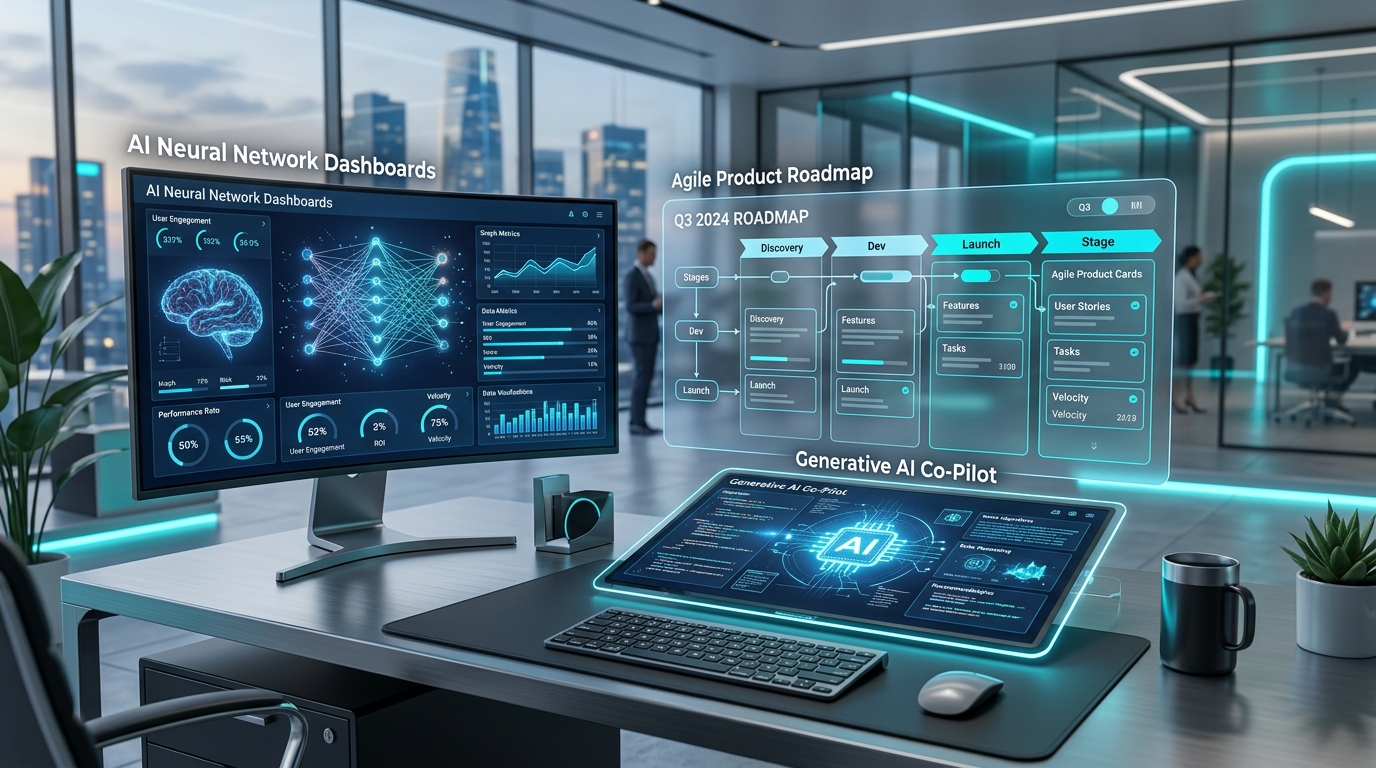
Artificial intelligence is changing how products are researched, designed, developed, launched, and improved. Product managers are increasingly expected to understand AI capabilities, evaluate use cases, work with technical teams, interpret data, and make decisions in rapidly evolving environments.
A Product Management Course with AI helps professionals build core product management skills while integrating artificial intelligence across the product lifecycle. Rather than treating AI as a separate topic, the course shows how product managers can use AI to identify opportunities, understand customers, prioritise features, develop strategies, analyse feedback, and support decision-making.
Learning AI product management gives aspiring and experienced product managers, entrepreneurs, business analysts, and technology professionals a practical foundation for working with modern digital products. Graduates can pursue roles such as Product Manager, AI Product Manager, Technical Product Manager, and Product Analyst. These positions are in high demand across industries including technology, finance, healthcare, retail, and education as organisations increasingly adopt AI solutions.
1. What Is a Product Management Course with AI?
A Product Management Course with AI combines core product management principles with practical AI applications.
Traditional product management involves understanding customer problems, defining product requirements, creating roadmaps, prioritising features, coordinating teams, launching products, and measuring performance. AI adds new possibilities to each of these foundational activities.
A modern, industry-aligned course covers areas such as:
The objective is to develop well-rounded professionals who can seamlessly connect business objectives, customer needs, engineering constraints, and AI capabilities to create truly useful and scalable products.
2. Why Learn AI Product Management?
Artificial intelligence has become part of many products used by consumers and businesses every single day. Search platforms, productivity applications, customer service tools, financial products, healthcare platforms, education technology, marketing software, and enterprise applications increasingly incorporate AI-powered features.
This creates a growing need for product professionals who understand both product management and AI. In turn, product teams need people who can work across both areas. A product manager does not necessarily need to become a machine learning engineer. However, understanding concepts such as machine learning, large language models (LLMs), generative AI, model limitations, data quality, AI evaluation, and responsible AI helps product managers communicate with technical teams and make better decisions.
Real-World Scenario: AI-Powered Customer Support Platform
For example, a product manager responsible for an AI-powered customer support platform may need to determine:
- What customer problem should the AI feature solve?
- Which customer interactions should be automated vs. kept human?
- When should a conversation be escalated and transferred to a human agent?
- What proprietary and public data should be used to train and ground responses?
- How should response quality and accuracy be measured?
- How should inaccurate or hallucinated AI responses be handled gracefully?
- What product metrics should determine whether the feature is successful?
These questions require both strategic product thinking and a sound understanding of AI capabilities and operational limitations.
3. Core Product Management Skills You Learn
A strong AI product management course should begin with the fundamentals of product management. Before deploying cutting-edge neural networks, a product manager must master how products are conceived, validated, and steered.
Product Discovery
Product discovery helps teams understand customer problems before investing significant engineering resources in a solution.
Learners master how to conduct qualitative customer interviews, analyse market information, identify genuine user pain points, develop falsifiable hypotheses, and validate potential solutions.
AI tools can help organise interview notes, identify recurring themes, summarise research, and generate research questions. However, product managers still need to evaluate the information's quality, context, and strategic relevance.
Product Strategy
Product strategy connects a high-level product vision with measurable business and customer outcomes.
Through practical case studies, you learn how to define:
For AI products, strategy must also critically consider whether AI provides meaningful, defensible value compared with conventional software approaches or heuristic automation.
Product Roadmapping
Product roadmaps help cross-functional teams understand product priorities, dependencies, and planned milestones.
An AI-enabled product roadmap incorporates specialized activities such as:
- AI feature discovery: Exploring where machine intelligence moves the needle.
- Data preparation & pipeline hygiene: Sourcing, cleaning, and labelling datasets.
- Model selection: Weighing open-source vs. proprietary APIs (e.g. GPT-4o, Claude 3.5, Llama 3).
- Prototype development: Rapid prototyping with prompt chains or lightweight mockups.
- AI evaluation: Validating accuracy, ground truth alignment, and toxicity guardrails.
- User testing: Observing how real users respond to probabilistic, non-deterministic outputs.
- Product integration: Embedding AI components into existing software stacks.
- Performance monitoring: Tracking drift, latency SLAs, and unit costs.
- Continuous improvement: Ongoing fine-tuning and feedback loop integration.
A product manager needs to skillfully balance customer value, business priorities, technical feasibility, computational resources, and risk.
4. How AI Can Help Product Managers
Beyond creating AI products, artificial intelligence actively enhances a product manager's day-to-day productivity and decision-making capabilities across multiple workflows.
AI for Market Research
Generative AI can help organise large amounts of research information and identify recurring topics across market reports, analyst whitepapers, and competitor websites.
Product managers can use AI to structure competitor research, summarise public earnings reports, generate qualitative interview questions, and organise market findings for further analysis. However, the product manager remains responsible for validating critical information before using it in strategic decisions.
AI for Customer Research
Customer interviews produce large volumes of qualitative transcripts and observational notes. AI assists product teams with:
Transcribing Conversations
Converting voice customer calls into searchable text in real time.
Summarizing Interviews
Extracting key takeaways, emotional sentiment, and pain points.
Categorizing Feedback
Auto-tagging feature requests, usability bugs, and pricing objections.
Identifying Recurring Problems
Clustering customer objections across hundreds of support tickets.
Insight Reporting
Generating executive briefs from qualitative discovery sessions.
Thematic Grouping
Mapping user quotes directly into empathy maps and customer journey phases.
This makes research synthesis faster, allowing product teams to spend more time evaluating what the findings mean for the product strategy rather than wrestling with manual tagging.
AI for Product Requirements
Product managers frequently create documents such as Product Requirement Documents (PRDs), user stories, acceptance criteria, and technical feature specifications.
AI can help create a cohesive initial structure based on clearly defined requirements. For example, a product manager could provide a feature objective and prompt an AI model to organise it into:
The product team reviews, stresses, and refines the draft, ensuring that nuance, security, and edge-case handling reflect actual customer realities.
AI for Feature Prioritisation
Feature prioritisation requires balancing customer value, business impact, development effort, strategic importance, and risk.
AI can help organise available feedback and structure potential features against industry-standard frameworks:
- RICE: Reach, Impact, Confidence, and Effort scoring.
- MoSCoW: Must-have, Should-have, Could-have, Won't-have categorization.
- Value vs. Effort: 2x2 matrix mapping high-impact quick wins.
- Kano Model: Basic needs, performance drivers, and customer delighters.
- Impact vs. Complexity: Technical feasibility vs commercial payoff.
AI helps structure the data inputs and highlight potential biases, but the product team establishes the criteria and validates the core assumptions behind every decision.
5. Generative AI for Product Managers
Generative AI is particularly relevant to modern product management because it can generate and transform text, analyse information, support brainstorming, and assist with structured workflows.
Product managers leverage generative AI daily for high-leverage tasks including:
The most effective approach is to treat AI output as a powerful starting point—a first draft that always requires human judgment, domain context, validation, and refinement.
6. Prompt Engineering for Product Managers
A useful Product Management Course with AI must introduce practical prompt engineering. Vague prompts yield superficial answers, whereas systematic prompts unlock production-grade documentation.
A well-structured prompt provides AI systems with:
This structured prompt produces concrete, actionable specifications, giving the product manager a solid foundation to refine with engineers.
7. AI Product Lifecycle
Building AI products requires special consideration throughout the product lifecycle, from initial problem identification to continuous post-launch iteration.
Identify the Problem
Define the customer problem thoroughly before introducing AI technology. Successful products address genuine pain points rather than searching for problems to match an existing model.
Evaluate the AI Opportunity
Determine whether AI can solve the problem effectively and justify the added complexity, infrastructure expenses, latency, and maintenance compared with traditional heuristics or rules.
Define the Product Requirements
Document functional, user experience, training data, accuracy thresholds, hallucination limits, latency budgets, and operational fallback requirements in an AI PRD.
Build a Prototype
The cross-functional team creates an early version—often using lightweight APIs, prompt chains, or Wizard of Oz testing—to validate the concept with users before full-scale engineering.
Evaluate AI Performance
AI features require evaluation criteria beyond typical unit tests, including accuracy, precision/recall, response relevance, latency, user satisfaction, and task completion rates.
Launch and Measure
After deployment, product teams closely monitor both core product metrics (retention, conversion) and AI-specific metrics (hallucination rate, user override rate, inference cost).
Improve Continuously
AI products require continuous monitoring and iteration because user behaviour, underlying datasets, LLM model versions, and business constraints continually shift over time.
8. AI Product Metrics
Measuring the health and ROI of an AI feature requires more than traditional product analytics. Product teams track a combination of business outcomes and model-specific telemetry:
The appropriate metrics depend on the product type. For example, an AI writing assistant may track feature adoption, acceptance rate of suggested text, and task completion speed. Conversely, an AI customer service product will monitor resolution rate, human escalation rate, response accuracy, and post-resolution CSAT.
9. Building an AI Product Portfolio
Practical projects add immense value to an AI product management course by helping learners apply concepts to realistic challenges and assemble a compelling professional portfolio. Deliverables such as presentations, PRD teardowns, demo videos, and documented workflows help candidates prove how they approach ambiguous product problems rather than simply presenting a course certificate.
A comprehensive capstone portfolio project could involve creating an AI-powered product concept from discovery to launch:
Having verifiable proof of work separates top candidates during competitive product hiring cycles.
10. Who Should Take a Product Management Course with AI?
A Product Management Course with AI is designed for several distinct professional backgrounds looking to build modern product leadership skills:
Aspiring Product Managers
Individuals moving into product management who want to learn core product fundamentals while developing future-proof AI proficiencies.
Existing Product Managers
Experienced product managers looking to upskill into AI-enabled product development, understand LLM capabilities, and integrate AI tools into their teams' workflows.
Business Analysts
BAs seeking to bridge business analysis with product strategy, translate complex stakeholder requirements, and evaluate technology-driven AI solutions.
Entrepreneurs and Founders
Startup founders seeking structured frameworks to validate customer ideas, prioritize MVP roadmaps, and assess AI integration opportunities efficiently.
Software and Technology Professionals
Software engineers, data scientists, and QA engineers wanting to transition toward product leadership, user discovery, strategic prioritization, and business decisions.
Marketing and Growth Professionals
Growth marketers working on digital products who want to master user journey mapping, rapid experimentation, and AI-powered feature adoption.
11. Career Opportunities After an AI Product Management Course
Completing a rigorous product management course with AI equips professionals for high-impact roles across digital enterprises, startups, and consulting firms:
To explore day-to-day duties, compensation, and required competencies in depth, read our dedicated guide on AI Product Manager Roles, Responsibilities & Skills.
Keep in mind that a course alone does not guarantee career outcomes. A high-value program provides mentorship from veteran product leaders, personalised PRD feedback, group projects simulating real product challenges, and mock interview practice.
12. How to Choose a Product Management Course with AI
When evaluating courses, look beyond marketing titles. Use this checklist to make an informed decision:
For an exhaustive comparison of programs in India, including fees and syllabus breakdowns, see our guide on AI Product Management Courses and Training in India.
13. Product Management with AI vs Traditional Product Management
Traditional product management remains vital because AI never replaces the fundamental need to understand customers and commercial business models.
The critical difference is that AI introduces non-deterministic outputs, data dependencies, and probabilistic trade-offs:
| Product Activity | Traditional Product Management | AI Product Management |
|---|---|---|
| Customer Research | Customer research & pain point mapping | Customer research plus AI use-case evaluation |
| Product Strategy | Roadmap to market viability & revenue | AI-enabled product strategy & defensibility |
| Feature Prioritisation | Value vs. engineering effort (RICE) | Feature prioritization with AI data & technical feasibility |
| Product Requirements | Functional & non-functional specs (deterministic) | Traditional PRD plus AI guardrails, latency & datasets |
| Product Analytics | Conversion, retention, bounce rates | Product analytics plus AI performance, drift & token costs |
| User Testing | Usability testing & prototype feedback | User testing plus model accuracy & hallucination evaluation |
| Product Launch | Feature rollouts, feature flags & marketing | AI feature launch, shadow deployments & live monitoring |
| Continuous Improvement | Iterative software bug fixes & UX polish | Continuous product, prompt, data & model retraining |
14. Practical AI Product Management Project Example
To see how these concepts come together, consider the development of an AI-powered recruitment platform:
Corporate recruiters spend significant manual hours reviewing large volumes of incoming applications, creating hiring bottlenecks.
High-growth recruitment teams and talent acquisition managers handling high application volumes.
Extract relevant career information from resumes using NLP/LLMs and match candidate profiles against predefined job competencies.
The system must provide transparent explanations showing why a candidate was ranked, allowing recruiters to inspect the underlying evidence.
A 60% reduction in time spent on initial resume screening while maintaining or improving hiring manager interview acceptance rates.
Mitigate demographic bias in screening models, implement anti-hallucination parsing guardrails, and maintain strict data privacy compliance (GDPR/DPDP).
This example illustrates why AI product management requires product thinking, technical understanding, user research, measurement, and responsible implementation.
15. Frequently Asked Questions
16. Conclusion
A Product Management Course with AI helps professionals develop the skills needed to build and steer products where artificial intelligence plays a decisive role. This learning journey blends foundational product principles with modern AI workflows.
Learners master customer discovery, product strategy, prioritisation, roadmapping, analytics, experimentation, and delivery while understanding how generative AI, machine learning, model evaluation, and automation reshape product decisions.
AI product management is ultimately about making sound, customer-centric product decisions in an environment where AI capabilities are rapidly evolving. A solid product foundation remains essential.
For anyone planning a career in AI Product Management, the ideal path involves practical projects, real product scenarios, structured frameworks, AI tools, rigorous documentation, and measurable outcomes. Building a portfolio with case studies, PRDs, prototypes, and analytics scorecards provides verifiable proof of your practical capabilities.
Looking to evaluate structured learning programs, industry certifications, and fee comparisons in India? Read our complete guide on AI Product Management: Skills, Career Path, Courses and Training in India to plan your career transition.
Build Your AI Product Portfolio with AcceleratorX
Master product discovery, AI PRDs, prompt engineering, model evaluation, and roadmapping with 1-on-1 mentorship from seasoned product leaders.
Explore Product Management Course