
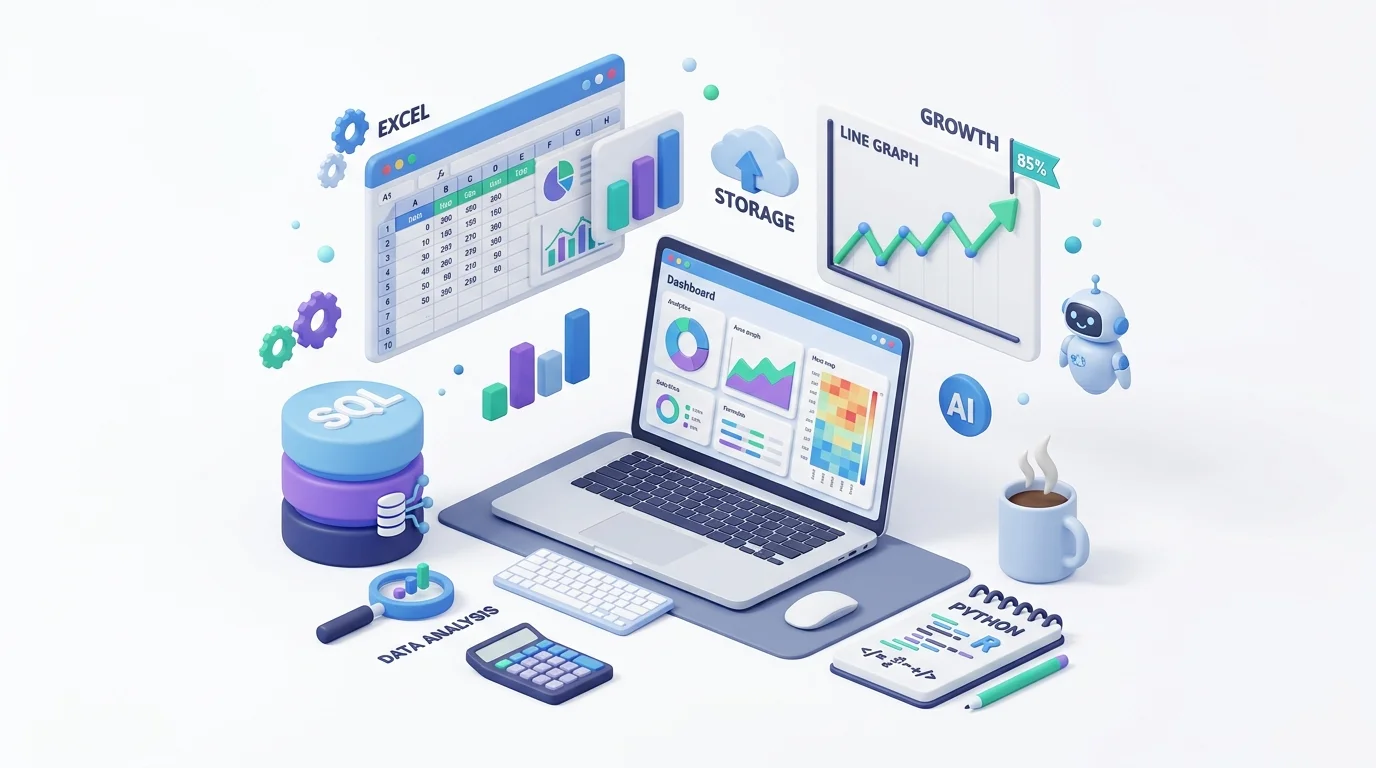
Competition for entry-level data roles is intense, and hiring managers often prefer candidates with practical, hands-on skills over standard resumes. If you want to launch a career in data analysis and do not have a specialised degree, concentrate on developing a succinct and highly effective range of skills.
This guide covers the core technical tools, soft skills, portfolio-building strategies, resume tips, and common interview questions you need to secure your first data analyst role in 2026.
Hard Skills Breakdown: The Core Technical Stack
Master these four tools to stand out; you do not need every programming language on day one.
Master pivot tables, dynamic arrays, and cross-referencing functions such as XLOOKUP. Excel remains the go-to tool for quick, on-the-spot business analysis and is required in nearly every entry-level data role.
Be at ease writing out joins, aggregations, and subqueries to obtain raw data. SQL is the single most important technical skill for data analysts — it enables direct access to enterprise databases without depending on IT.
Learn how to convert raw data tables into clear visual reports using Power BI or Tableau. Executive teams rely on interactive dashboards to monitor KPIs in real time, making this skill indispensable.
Learn basic libraries such as Pandas for automating data-cleaning tasks. Python skills enable you to handle large datasets, automate repetitive workflows, and perform exploratory data analysis at scale.
💡 Learning Path: You can learn this stack step by step with a structured online data analytics course for beginners. Well-regarded alternatives include the Google Data Analytics Professional Certificate, Coursera, edX, or DataCamp.
Soft Skills That Set Top Candidates Apart
Technical skills get your resume looked at, but soft skills secure the job. These skills build on the technical foundation above and help you stand out further:
Understanding how metrics directly affect business operations, revenue, and churn.
Breaking down complicated, vague business problems into clear analytical steps.
Presenting complex statistical results in simple terms so that non-technical leaders can understand them.
How to Build a Portfolio Without Industry Experience
Employers want evidence of your experience. Create a portfolio website with three specific real-life projects that meet business needs or correspond to current business trends, using the skills above as your guide.
An exploratory analysis that extracts insights from a public database. For example, analyse customer churn patterns from a SaaS company's open dataset or track sales trends for a retail business.
Create an interactive executive dashboard to track business metrics over time. For example, build a live revenue and margin tracking dashboard with drill-down by region and product category.
Create an automated script for data cleaning or an exploratory data analysis (EDA) pipeline. Document your methodology and include the code on GitHub with a clear README.
Record your methodology, highlight the main business insights, and make your project code available on GitHub. Prepare a straightforward README file to guide employers through your reasoning and the results you obtained.
Resume and Interview Preparation Tips
Make your resume suitable for applicant tracking systems (ATS) by concentrating on business results rather than listing tasks:
"I produced some reports using Excel and SQL."
"Set up an automated workflow using SQL and Power BI which cut the time required for monthly reporting by 15 hours."
🎯 Career Support: Our data analyst course with placement assistance provides professional resume reviews and mock interviews to help you land your first role.
Common Entry-Level Interview Questions
Be ready to discuss basic concepts, your technical skills, and how you approach business problems. These sample questions connect your answers to the skills and projects described above:
Describe a recent project in which you applied data to resolve a business problem.
What method would you use when cleaning a messy dataset? What measures do you take to check data quality?
What is the difference between an INNER JOIN and a LEFT JOIN in SQL?
What is the way of prioritising several projects when they have tight deadlines?
How would you explain a technical finding to a non-technical stakeholder?
Frequently Asked Questions
Start Your Data Career Today
Mastering data analytics creates opportunities across every major industry. Gain the technical skills in SQL, Excel, Power BI, and Python, build a strong portfolio of three real-world projects, and earn a qualification that sets you apart in the job market.
Focus on business outcomes rather than technical complexity. Every project you complete, every dashboard you build, and every SQL query you write brings you one step closer to your first data analyst role.
Learn SQL, Power BI, Python, and Excel with hands-on projects, career support, and an industry-recognised certificate from AcceleratorX.
Enrol in the Data Analytics Course