
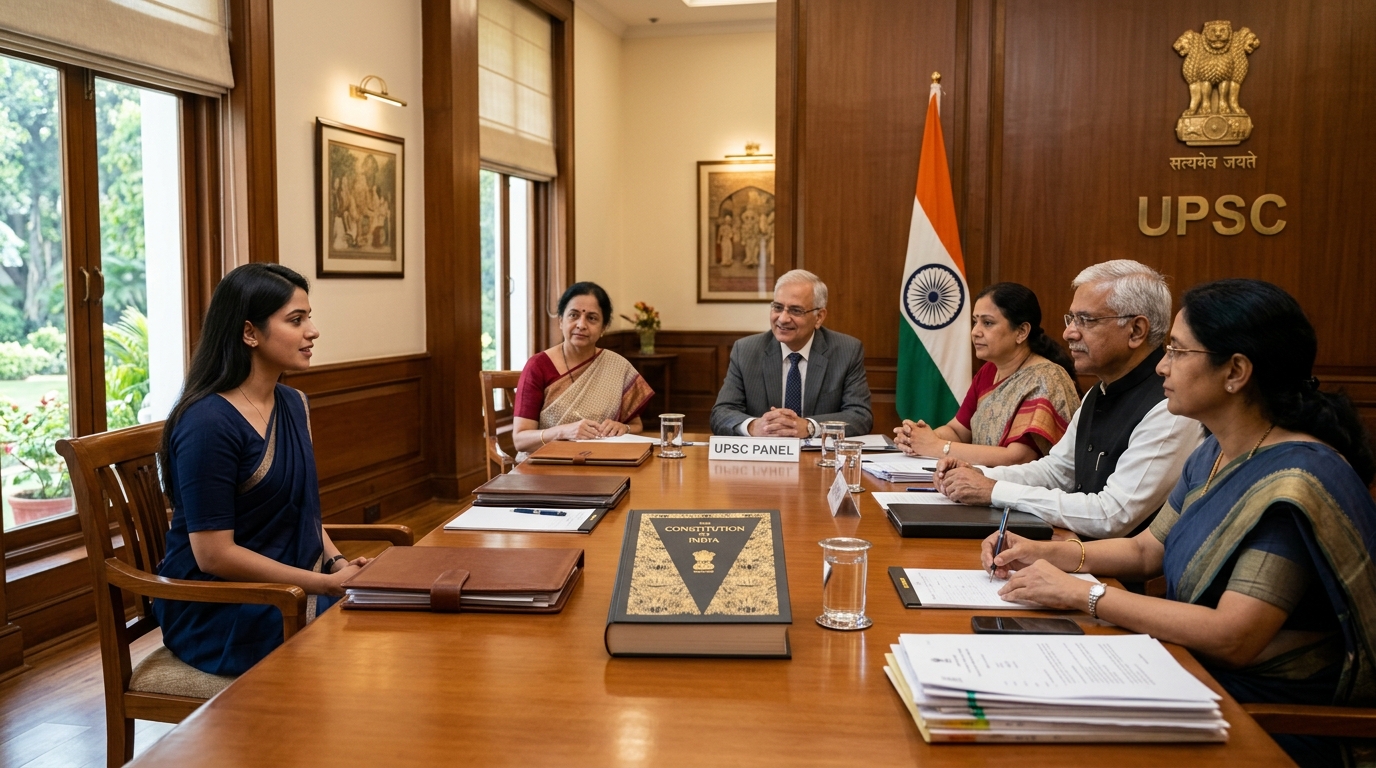
The UPSC interview, officially known as the Personality Test, is the final stage of the Civil Services Examination. Candidates who qualify for the Main Examination are called for the Personality Test, where the Union Public Service Commission evaluates qualities such as judgment, clarity of thought, awareness, communication skills, intellectual curiosity, balance of opinion, and suitability for public service.
If you have chosen an optional subject for the UPSC Civil Services Examination, expect the interview board to discuss it. They may ask about your academic background, why you chose the subject, recent developments, and its relevance to administration and society. Examples include:
Practising these sample questions will help you anticipate and prepare effective interview responses.
Understanding the pattern of UPSC interview optional subject questions enables more systematic preparation and greater confidence. Start by reviewing previous interview transcripts or listing likely questions for your subject clearly and with focus.
1. What Are UPSC Interview Optional Subject Questions?
UPSC interview optional subject questions are inquiries the interview board poses about the optional subject a candidate selected for the Civil Services Main Examination.
The board explores the subject from several perspectives. Questions range from basic concepts to contemporary applications, depending on the candidate’s educational background, Detailed Application Form (DAF), optional subject, and the interview's organic direction:
- Political Science & International Relations: Constitutional institutions, diplomacy, federalism, geopolitics, and foreign policy shifts.
- Geography: Urbanisation, climate change, population distribution, resource management, agriculture, or geographical determinants of development.
- History, Sociology, Public Administration, Economics, Philosophy & Anthropology: Connecting core sociological or administrative theories to current governance challenges.
- Science, Engineering, Law & Literature: How technical methods, constitutional jurisprudence, or regional cultural traditions apply to contemporary public policy.
The key point is that the Personality Test is not another written examination. The board uses the optional subject as a starting point for an insightful, open-ended intellectual conversation.
2. Why Does UPSC Ask Questions About the Optional Subject?
The optional subject provides the interview board with an opportunity to understand how a candidate approaches a specialized field of knowledge. Questions test whether the candidate can:
Avoid relying solely on textbook definitions. Instead, prepare by understanding foundational concepts, their real-world applications, current relevance, limitations, and potential administrative implications.
3. Types of UPSC Interview Optional Subject Questions
Optional-subject questions generally fall into five distinct categories:
1. Basic Conceptual Questions
The board often starts with a straightforward question from your optional subject (e.g., "What is federalism?" or "What is the difference between monetary and fiscal policy?").
While the question appears simple, the board uses your answer to evaluate clarity of thought and segue into deeper follow-up discussions. Be prepared to explain fundamental concepts clearly, without relying on dense jargon.
2. Questions Based on Academic Background
If your optional subject matches your graduation or postgraduate education, the board expects greater conceptual rigor. For instance, an Economics graduate who selected Economics as an optional subject will be questioned on inflation targets, fiscal deficits, banking sector reforms, and exchange rates.
3. Questions Connecting Optional Subjects with Current Affairs
Current affairs intersect with virtually every UPSC optional subject:
Inflation trends, employment generation, fiscal deficit, GST, and RBI monetary policy.
Climate change impacts, urban flooding, groundwater depletion, and disaster management.
Electoral reforms, cooperative federalism, judicial reviews, and regional geopolitics.
Demographic transition, caste dynamics, urbanisation, gender parity, and family structures.
Cultural heritage conservation, colonial legacy debates, and contemporary historical memorials.
Citizen charters, digital e-governance initiatives, civil services reforms, and police accountability.
4. Opinion-Based Questions
The board may ask for your stance on a controversial or complex dilemma (e.g., "Do you think rapid urbanisation benefits India?"). The goal is not to deliver an extreme, dogmatic opinion, but to demonstrate that you can systematically weigh multi-dimensional perspectives before reaching a balanced conclusion:
5. Application-Based Questions
These questions challenge candidates to apply theoretical models directly to grassroots governance problems (e.g., "How can administrative reforms improve service delivery at the district level?"). Always anchor theoretical knowledge in real-world governance realities.
4. UPSC Interview Questions for Major Optional Subjects
Below is an overview of high-probability topics and sample questions across the six most popular optional subjects:
Political Science and International Relations (PSIR)
Key Revision Areas: Indian Constitution, Fundamental Rights, Directive Principles, Parliamentary sovereignty, Judicial activism, Cooperative federalism, Local self-government, Electoral reforms, Global multilateralism, India-US relations, India-China border diplomacy, Neighbourhood First policy, and Strategic autonomy.
Geography Optional
Key Revision Areas: Geomorphology, Monsoon dynamics and El Niño, River interlinking, Groundwater depletion, Agro-climatic regionalisation, Industrial corridors, Urban master planning, Coastal zone management, and Disaster vulnerability mapping.
History Optional
Key Revision Areas: Indus Valley urban planning, Mauryan & Gupta administrative structures, Bhakti & Sufi traditions, 1857 uprising causes, Freedom movement factions, Tribal revolts, Constitution-making debates, and Heritage conservation policies.
Sociology Optional
Key Revision Areas: Caste continuity and change, Sanskritization, Agrarian distress and farmer movements, Changing kinship & joint family structures, Urban slums, Tribal integration policies, Women in the workforce, and Social media’s impact on community cohesion.
Public Administration Optional
Key Revision Areas: Weberian bureaucracy vs New Public Management, Citizen’s Charters, RTI implementation, E-governance portals, Police reforms, District collector role evolution, Panchayati Raj devolution, Lateral entry in civil services, and Ethical dilemmas in discretionary decisions.
Economics Optional
Key Revision Areas: Inflation targeting and CPI vs WPI, Fiscal consolidation path (FRBM), External debt management, Rupee exchange rate volatility, Jobless growth debates, Agricultural MSP formulas, Free Trade Agreements (FTAs), and Universal Basic Income (UBI).
5. How to Prepare for UPSC Interview Optional Subject Questions
Revise Your Optional Subject Fundamentals
Start with the syllabus you studied for the Main Examination. Focus on revising essential concepts and definitions rather than attempting to re-read every thick textbook from scratch. This revision ensures that you can explain core principles with precision.
Connect Your Optional Subject with Current Affairs
Read daily editorials through the conceptual lens of your optional subject. For instance, if your optional is Geography and news reports cover recurrent urban deluges, immediately analyze rainfall anomalies, natural drainage blockages, land-use zoning, and National Disaster Management Authority (NDMA) guidelines. This establishes natural synergies between static theory and dynamic governance.
Prepare Questions from Your DAF
Your Detailed Application Form (DAF) is the primary blueprint used by the interview board. Interlink your personal background with your optional subject:
- If your home district experiences severe soil salinity or floods and you have Geography as your optional, prepare local solutions.
- If you list classical music as a hobby and have Public Administration as an optional, consider questions on government cultural grants, autonomy of academies, and support for folk artists.
- If you graduated in Computer Science but opted for Sociology, prepare a solid justification explaining why you chose a humanities subject and how technological tools intersect with societal change.
6. How to Answer Optional Subject Questions in the UPSC Interview
An impactful answer should reflect four key attributes:
Logical sequence from definition to conclusion
Acknowledge trade-offs and counter-views
No fabricated statistics or unverified data
Answer crisp and invite natural conversation
Question: "What is the significance of decentralisation in India?"
Model Structured Response:
"Decentralisation refers to the systematic transfer of decision-making authority, administrative responsibilities, and financial resources from central and state authorities to local self-governing bodies.
It is significant in India because it promotes more responsive, participatory, and accountable governance by bringing administration directly to the grassroots. For example, the 73rd and 74th Constitutional Amendment Acts legally empowered Panchayati Raj Institutions and Urban Local Bodies to plan and execute local development schemes.
However, operational bottlenecks—namely inadequate financial devolution (funds), shortage of technical manpower (functions), and bureaucratic tutelage (functionaries)—often constrain grassroots autonomy. To maximize its impact, states must devolve taxation powers and build capacity at the grassroots while instituting robust social audits for transparency."
Avoid reciting rehearsed speeches. Keep the tone warm, respectful, and engaging.
7. What If You Do Not Know the Answer?
Candidates are not expected to be walking encyclopedias. The interview evaluates how you maintain composure, self-awareness, and humility when tested.
If you do not know a factual answer, state so honestly rather than guessing or dissembling:
If you know part of the answer, explain the portion you are confident about and clearly state where your certainty ends. The panel respects intellectual integrity above all else.
8. Common Mistakes in UPSC Interview Optional Subject Preparation
Memorising Model Answers
Rigid, scripted answers sound artificial and fall apart under probing follow-up questions from senior board members.
Ignoring Basic Concepts
Aspirants frequently get lost in complex theoretical debates while forgetting fundamental textbook definitions and principles.
Giving Extreme Opinions
Adopting one-sided ideological stances without acknowledging administrative trade-offs signals stubbornness rather than administrative maturity.
Using Unverified Statistics
Quoting inaccurate data or speculative figures harms your credibility immediately. Only cite figures you can verify.
Overexplaining
Speaking continuously for minutes without pausing exhausts the panel. Answer the specific question, then pause for the board's reaction.
Treating the Interview Like the Mains Examination
The Personality Test is an interpersonal discussion assessing your demeanor, composure, and emotional intelligence—not an oral essay test.
9. UPSC Interview Optional Subject Questions: Preparation Checklist
Review this targeted checklist to ensure thorough preparation before entering Dholpur House:
10. Final Preparation Strategy for Optional Subject Questions
Prepare your optional subject at three systematic tiers:
Master definitions, foundational theories, structural concepts, thinkers, and major classical debates associated with your subject.
Understand how your discipline helps analyze practical challenges in district administration, economy, social cohesion, and policymaking.
Actively connect optional topics with breaking national news, policy announcements, Supreme Court verdicts, and global events.
Practical Weekly Exercise: Current Affairs Mapping
To cultivate spontaneous conversational agility, regularly map connections between your syllabus topics and recent news. Each week, select one topic from your syllabus and list corresponding real-world events, court judgements, or policy changes.
For example, if your optional is Geography and the topic is 'Urban Flooding', document recent monsoon incidents across Mumbai or Delhi and correlate them with storm drainage capacity, natural wetland encroachment, and satellite radar early warnings. Creating this weekly linkage matrix trains your mind to deliver deep, spontaneous, and contextual answers.
11. Frequently Asked Questions
12. Conclusion & Final Tips
The UPSC interview often begins with a simple question about your optional subject before progressing to your background, administrative philosophy, and public service ethos.
Preparing for these multifaceted connections—rather than relying on memorised scripts—is the key to making a lasting positive impression. Focus on conceptual clarity, link theory to governance, maintain balanced judgment, and stay calm under pressure.
For an all-inclusive breakdown of the Personality Test process, DAF preparation, dress code, and interview board transcripts, read our complete guide on UPSC Personality Test and Interview Questions.
Practice Realistic UPSC Mock Interviews
Prepare with real-time feedback, DAF profiling, and subject-specific follow-up questions tailored to your optional subject.
Start AI Mock Interview Prep