
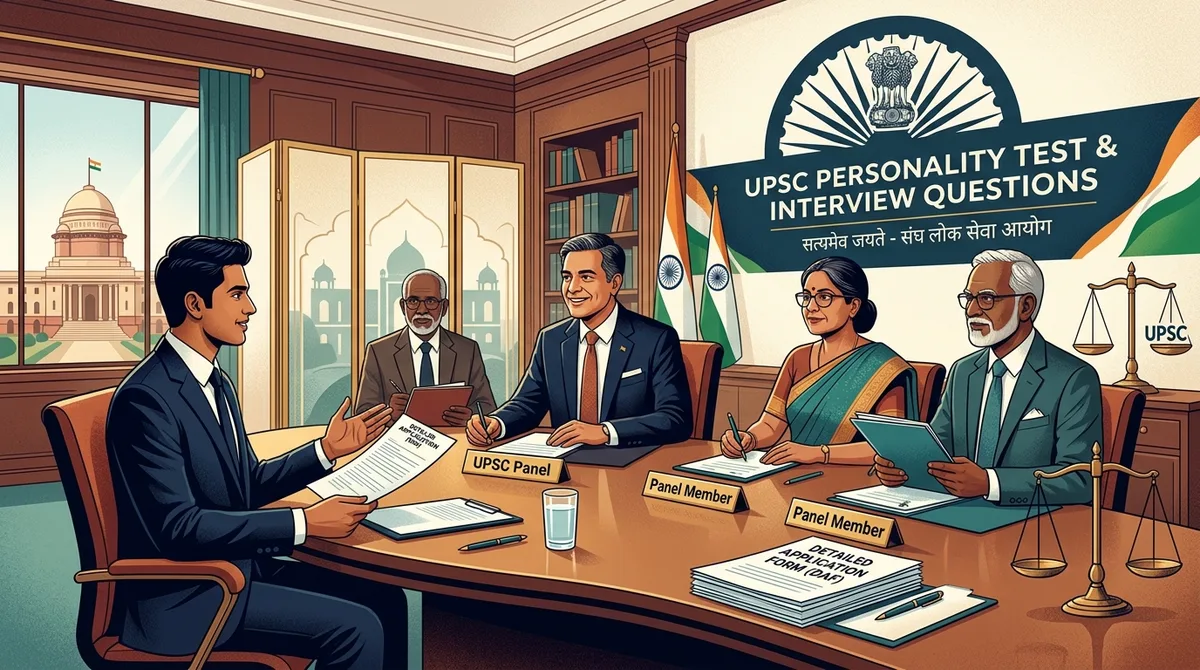
The UPSC personality test is the final stage of the Civil Services Examination. It assesses whether a candidate has the character, judgment, communication skills, awareness, and qualities needed for public service.
The UPSC interview differs from a classic academic examination because it is not limited to factual knowledge; the board may ask about your Detailed Application Form (DAF), educational background, work experience, hobbies, optional subject, current affairs, and situational judgment.
This guide covers the UPSC Personality Test, typical UPSC interview questions, DAF-based questions, preparation, dress code, marks, common errors, and other important points. It also presents practical advice and strategies to help you prepare properly and feel confident.
What does the UPSC personality test entail?
The Character Test organised by the UPSC is an interview held after candidates take the Civil Services Main Examination; only those who qualify are invited to Dholpur House in New Delhi.
The Character Test evaluates characteristics relevant to public service. These core traits include:
The board may ask direct, follow-up, opinion-based, and hypothetical questions to observe how comfortably and logically you think on your feet.
What takes place during the UPSC interview?
The interview usually begins with cordial questions about the candidate's background and then moves smoothly to other topics based on the answers given. The board aims to establish a conversational, respectful atmosphere to observe your natural demeanour.
Questions may originate from multiple interconnected dimensions:
- Detailed Application Form (DAF): Your personal bio-data, schooling, college, achievements, and family background.
- Educational qualification: Core concepts, recent academic developments, and real-world relevance.
- Place of birth or residence: Socio-economic profile, local challenges, cultural heritage, and district issues.
- Work experience: Industry insights, operational challenges, leadership learnings, and reason for leaving.
- Hobbies and interests: Authentic passion, depth of interest, and connection with personal growth.
- Optional subject: Conceptual depth, practical administrative application, and theoretical foundations.
- Current affairs & Government policies: National and international headlines, socio-economic debates, and policy trade-offs.
- Situational & administrative scenarios: Crisis response, resource constraints, ethics, and conflict resolution.
There is no fixed or predetermined list of questions for all candidates. Your answers organically shape the direction and questions that follow.
UPSC Interview Questions
UPSC interview questions range from straightforward personal inquiries to nuanced dilemmas requiring balanced analysis. Typical categories include:
- • What prompted you to enter the civil services despite having lucrative private sector or academic options?
- • Please tell us something significant about your educational background and your institution's legacy.
- • What specific operational lessons did you pick up from your earlier professional work experience?
- • What are the primary difficulties currently being faced by urban governance and municipal corporations?
- • Which innovative measures can be taken to improve primary healthcare and public services in remote rural areas?
- • What ought to be India's priorities when it comes to improving youth employment and manufacturing competitiveness?
- • What is your reasoned critique of a recently introduced government policy or reform?
- • How should a district administration strike a balance between developmental projects and environmental conservation?
- • What is the most appropriate way for a district magistrate to react to a sudden public crisis?
The aim is not to give a single "correct" answer. Instead, candidates must demonstrate clarity of thought, sound reasoning, constitutional perspective, awareness of the issue, and an unshakeable, balanced response.
DAF-Based Questions in UPSC Interview
DAF-based questions form the core foundation of UPSC interview preparation because every board member holds a copy of your Detailed Application Form (DAF-I and DAF-II).
Your DAF directly prompts questions regarding:
Consider these specific real-world examples:
- Photography: If you list photography, the board might ask about technical principles (aperture, ISO, dynamic range), photojournalism ethics, or how imagery drives public social movements.
- Music: If your hobby is classical music, you could be asked about differences between Hindustani and Carnatic traditions, the societal impact of music, or the contributions of legendary maestros.
- Trekking: If you list trekking, expect inquiries about major Himalayan routes, high-altitude ecology, disaster management in sensitive valleys, and sustainable ecotourism.
- Volunteering / NGO work: Board members will explore the measurable impact of your contribution, root community grievances, and policy gaps you witnessed firsthand.
- Sports: If you represented your college or state, be prepared for questions on sporting governance, anti-doping regulations, recent Olympic achievements, and building grassroots sports infrastructure.
💡 Pro Tip on DAF Preparation: Prepare a comprehensive dossier on every keyword written in your DAF. From the historical significance of your birthplace to your college motto and work achievements, no detail is too small.
UPSC Interview Hobby Questions
Hobbies reflect your personality, stress-relief mechanisms, and intellectual vitality outside of academic study.
If you mention reading as a hobby, questions could include:
- What specific genres or themes do you gravitate toward?
- Who is your favourite author, and what is their philosophical worldview?
- Which book have you read recently, and what critical lessons did you take away?
- How has reading literature shaped your emotional intelligence and administrative worldview?
If you bring up cricket, the board might ask about the economics of the IPL, cricket diplomacy in South Asia, governance reforms in the BCCI, or comparisons with Olympic disciplines in India.
The best approach is to state genuine hobbies that you actively pursue. Outline their fundamentals, historical origins, recent developments, and broader socio-administrative links.
Optional Subject Questions
The optional subject you selected for the Mains examination will be closely scrutinised. The board evaluates your command over basic concepts and how effectively your academic training transfers into public policy.
The board typically asks questions related to:
- Core foundational principles and major theoretical frameworks.
- Useful real-world applications in district administration.
- Recent contemporary debates, Nobel prize research, or policy controversies.
- Your scholastic background and reasons for choosing or transitioning to this optional subject.
- The relevance of your optional subject (e.g. Public Administration, Sociology, Geography, History, Law, Engineering) to modern governance.
Rather than re-reading thousands of pages of granular notes, focus on revising the core concepts. Take concise synthesis notes, practise articulating theories simply, and discuss fundamental applications with mentors or peer study groups.
Current Affairs for UPSC Interview
Those preparing for the UPSC Personality Test should keep up with current affairs and focus on understanding significant developments rather than memorising endless statistical facts.
Important thematic areas include:
For each major ongoing issue, understand:
- What happened? The basic facts and context.
- Why did it happen? The underlying structural causes and historical backdrop.
- What are the consequences? The socio-economic, environmental, or diplomatic ramifications for India.
- What should be done? Pragmatic, progressive, and feasible administrative solutions.
Situational Questions in UPSC Interview
Situational questions assess how you handle real crises, ethical dilemmas, and administrative gridlock under pressure.
"If you are posted as a District Magistrate and a volatile public protest breaks out at a major intersection threatening communal harmony, what immediate and sequential actions would you take?"
An appropriate response demonstrates a calm, disciplined, and systematic methodology:
Gauge the scale, underlying catalyst, and immediate threat to human life and critical public infrastructure.
Deploy law enforcement personnel with non-lethal crowd control measures and establish secure perimeters.
Rely on ground reports from local sub-divisional magistrates, intelligence units, and trusted community monitors to prevent misinformation.
Engage immediately with community elders, protest leaders, and local representatives in an open channel to defuse tensions.
Ensure all administrative orders (Section 144, internet suspensions, or traffic diversions) follow constitutional due process and necessity tests.
Address urgent grievances while clearly communicating government resolution timelines.
Review structural causes, repair civic damages, and institute long-term confidence-building measures.
Do not offer hasty or extreme answers; instead, articulate your reasoning with calm composure and constitutional wisdom.
UPSC Interview Dress Code
You do not need an elaborate or expensive outfit for the Personality Test. The goal is to wear clean, formal, comfortable, and respectable attire that conveys professional gravitas.
- • Light-coloured formal shirt (white, light blue, or cream) paired with dark formal trousers (navy, charcoal, or black).
- • A formal necktie in sober tones (optional but recommended).
- • A well-tailored two-piece lounge suit is appropriate during winter sessions.
- • Clean, polished black or dark brown formal leather shoes with matching dark socks.
- • Well-groomed hair and neatly trimmed facial hair.
- • An elegant, sober cotton, silk, or handloom Saree in subtle pastel or light shades.
- • Alternatively, a neat formal Salwar Kameez or Churidar suit with a dupatta.
- • Formal Western business wear (formal trousers and blazer) is also completely acceptable if comfortable.
- • Minimal, dignified jewellery and comfortable, quiet footwear.
- • Neatly tied hair ensuring maximum focus remains on your conversation.
What matters most is maintaining a neat, professional look that allows you to feel completely comfortable and confident.
UPSC Interview Marks
The Personality Test in the Civil Services Examination carries a significant weightage of 275 marks.
Because interview scores range anywhere from 120 to 210+ marks, a difference of 30–40 marks in the personality test frequently decides whether an aspirant qualifies for the Indian Administrative Service (IAS), Indian Foreign Service (IFS), or misses the final list entirely.
Common UPSC Interview Mistakes
Even brilliant candidates make avoidable mistakes during the Personality Test. Being mindful of these pitfalls is essential:
Reciting coaching institute model answers without engaging deeply with the nuances of the board's question.
Trying to guess or fake an answer when you don't know the facts. The board has decades of expertise and detects bluffing immediately.
Rambling without getting to the core point. Keep responses concise, crisp, and structured in 1–2 minutes.
Reacting aggressively when board members challenge your opinion or present counter-arguments.
Spending weeks on obscure international news while failing to recall details about your graduation thesis or hometown.
Taking dogmatic stances without appreciating administrative constraints, legal frameworks, or counter-perspectives.
Speaking too fast due to nervousness instead of taking a composed 2-second pause before articulating.
Interrupting a board member or answering before understanding the core premise of the question.
It is always wiser to admit with polite humility when you do not know an answer rather than attempt to fabricate information.
UPSC Mock Interview Online
Candidates can use an online UPSC mock interview to practice responding to dynamic questions under authentic, timed interview conditions.
A high-yield mock interview experience covers:
- Comprehensive DAF-based probing covering all biographical entries.
- Real-time current affairs, economic indicators, and multilateral relations questions.
- In-depth examination of your hobbies, interests, and sports.
- Optional subject conceptual revisions and real-world administrative utility.
- Realistic situational and crisis management scenarios.
- Objective assessment of speech pace, filler words, vocal tone, and reasoning structure.
🚀 Smart Practice: Looking to practice answering unpredictable questions with instant objective feedback? Explore our AI Interview Prep Platform or learn more about AI mock interview online practice to sharpen your communication before the board.
Following each mock session, review your recording: assess your posture, eye contact, body language, pauses, and logical transitions. Constructive feedback is a stepping stone to calm confidence.
UPSC Interview Board and Transcript
The UPSC interview board consists of a distinguished panel led by a UPSC Member (acting as the Board Chairperson), accompanied by 4 or 5 subject-matter experts, retired diplomats, senior civil servants, and eminent educators.
Studying previous candidates' interview transcripts helps you understand:
- How board chairpersons transition from light introductory banter to serious policy analysis.
- How questions evolve based on candidate keywords.
- The tone of polite disagreement and how successful aspirants defend their viewpoints without being confrontational.
However, do not assume questions will be repeated. Transcripts teach you the style, rhythm, and structure of the discussion, not a static question bank to memorise.
How to Prepare for the UPSC Personality Test
A structured preparation plan can be organized into five systematic pillars:
Examine every single word in DAF-I and DAF-II. Compile thorough notes on your hometown, school, university, past companies, achievements, hobbies, and state governance issues.
Read at least two national daily newspapers (The Hindu / The Indian Express) and credible international digests. Form well-reasoned, multi-dimensional viewpoints on controversial public debates.
Reading alone is insufficient. Practice speaking your answers out loud before a mirror or camera. Keep answers structured (Background → Core Argument → Balanced Solution).
Work through real-world administrative dilemmas: communal tensions, disaster relief, corruption pressures, and technological disruption. Always ground your actions in constitutional ethics and rule of law.
Take mocks with diverse boards to uncover blind spots in knowledge, tone, or posture. Implement feedback iteratively to enter the interview hall with poised self-assurance.
Frequently Asked Questions About UPSC Personality Test
Conclusion & Final Tips
The UPSC Personality Test requires preparation across personal background, DAF-based questions, current affairs, hobbies, optional subject, situational questions, and communication.
Instead of preparing rigid, canned answers for every possible UPSC interview question, focus on understanding your own profile, developing balanced views, improving authentic communication, and practising different question scenarios.
A structured preparation strategy, regular speaking practice, and realistic mock interviews will help you approach the Character Test with greater assurance and certainty.
In addition, managing pre-interview stress is essential to keeping composed on the day of the interview. Simple relaxation or mindfulness techniques—such as deep breathing exercises, short meditation sessions, or brief walks—lower cortisol, soothe anxiety, and keep your mind sharp. Practising these strategies regularly in the days leading up to your interview will bring out your most natural, articulate, and impressive self before the UPSC board.
Experience real-time interactive AI mock interviews with instant voice, behavioral, and content feedback powered by AcceleratorX.
Start AI Mock Interview Free