
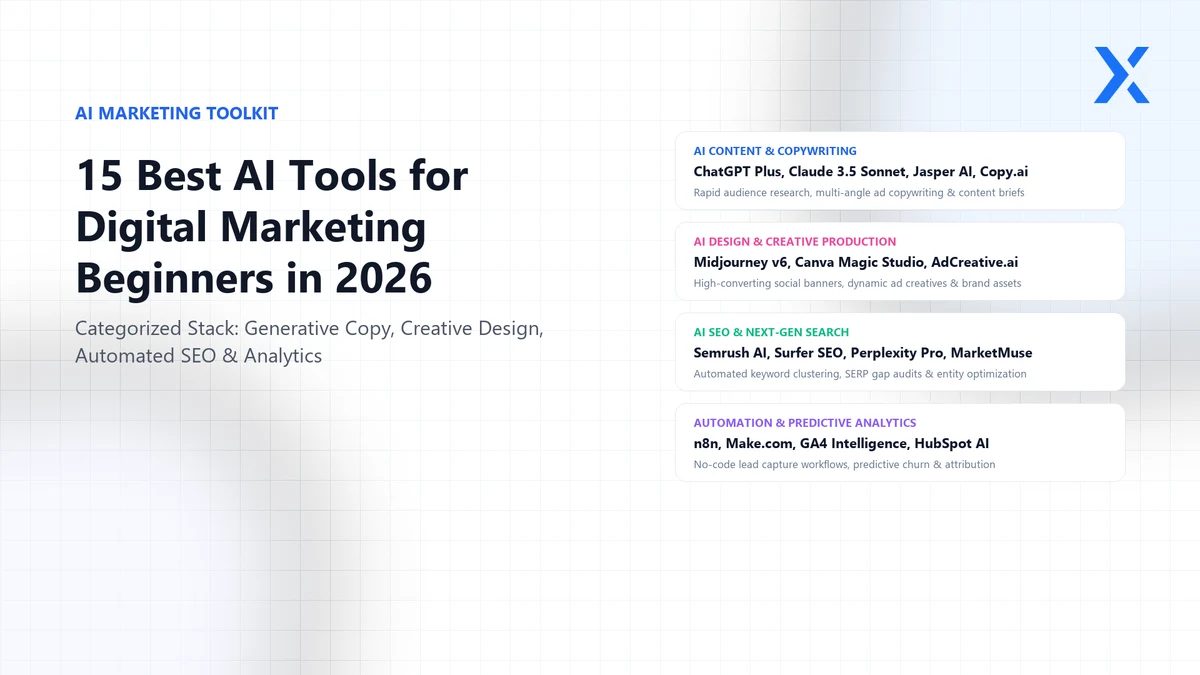
Artificial intelligence offers unprecedented ways to plan content, research competitor strategies, evaluate campaign data, and automate repetitive marketing tasks. Beginners can use AI tools to master core marketing skills rapidly—provided they understand exactly what each software is designed for and where its limitations lie.
For instance, a beginner might use generative AI to brainstorm hook angles, write engaging social media captions, or edit drafts for clarity. This saves countless hours and builds confidence. Rather than signing up for dozens of expensive tools, select a focused toolkit that maps directly to your immediate learning goals.
1. AI Tools for Content Research and Writing
Conversational assistants like ChatGPT, Claude, and Perplexity empower marketers to brainstorm angles, generate article outlines, draft catchy headlines, and uncover customer questions.
For example, when creating a guide on email marketing, you can prompt an AI assistant to identify the top 10 questions beginners ask and structure a logical outline. However, you must always fact-check your drafts before publication.
Beginner Review Checklist for AI Copy:
- Verify all factual claims, data points, and third-party references.
- Ensure originality by injecting personal examples and company context.
- Align the tone and vocabulary with your target reader persona.
- Prune vague filler phrases and overly repetitive buzzwords.
- Read drafts aloud to catch awkward phrasing and robotic cadence.
2. AI-Assisted SEO Research
AI capabilities integrated into platforms like Semrush and Ahrefs assist in clustering keywords, identifying semantic search trends, and generating content briefs.
As a beginner, learn to evaluate true search intent, keyword difficulty, and organic SERP competition rather than blindly trusting automated keyword difficulty scores. Inspect the top 5 ranking pages: are they informational blog posts, commercial comparisons, or transactional product pages? Ensure your content matches the underlying searcher intent.
3. AI for Social Media Marketing
Social media platforms reward consistency. AI tools help generate content calendars, suggest caption hooks, repurpose long-form articles into carousel slides, and schedule updates.
For a practical exercise, construct a 30-day multi-channel calendar for a local brand, integrating educational carousels, customer testimonials, and clear calls to action. Ensure every post reflects the unique aesthetic and tone of each platform.
4. AI in Paid Advertising
Google Ads and Meta Ads offer powerful native automated bidding, lookalike modeling, and dynamic creative delivery. AI can accelerate headline generation and audience segmentation, but campaign success depends entirely on human fundamentals: verified conversion tracking, disciplined budget pacing, and lead quality audits.
Always configure your tracking pixel or server-side conversion API carefully. Automated bidding algorithms cannot optimize effectively if they are fed inaccurate conversion signals.
5. AI for Analytics and Reporting
Google Analytics 4 (GA4) provides predictive audiences and automated anomaly detection. Connecting GA4 to modern visualization dashboards allows you to spot sudden traffic spikes or conversion drops quickly.
AI assistants can summarize complex weekly reports into plain-English takeaways. However, always verify automated summaries against raw metrics before presenting them to stakeholders.
6. AI for Marketing Automation
Automation platforms (such as Zapier, n8n, and HubSpot) seamlessly connect lead forms, CRM databases, email responders, and notification channels.
Start by building a straightforward workflow: automatically route new form inquiries into a CRM, assign an automated welcome sequence, and notify the sales representative on Slack. Test edge cases thoroughly to ensure customer data is treated securely.
How Should Beginners Choose AI Tools?
Before subscribing to premium tools, evaluate them using this practical framework:
Does the tool solve a specific, high-frequency marketing friction point?
What is the transparent pricing structure after the free trial expires?
How easy is it to connect the software with your website, CRM, or ad accounts?
Does the platform maintain strict customer data privacy and security?
Can you achieve 80% of the desired output using free, accessible tiers first?
Learn AI Tools Through Practical Training
Tool proficiency is only valuable when rooted in marketing strategy. Software changes rapidly, but core marketing principles—search intent, messaging, conversion funnels, and data attribution—remain constant.
To learn how to integrate these tools into an end-to-end campaign architecture, explore our in-depth guide on AI digital marketing courses in Bangalore.
Conclusion
AI tools can dramatically accelerate research, content creation, paid campaigns, analytics, and automation. Choose tools that directly solve real bottlenecks, verify outputs rigorously, and focus on delivering measurable campaign results.
Master Leading AI Marketing Tools
Learn to deploy ChatGPT, Claude, Semrush, Meta Ads, and n8n inside real business campaigns with AcceleratorX's live 16-week AI Digital Marketing Program.