
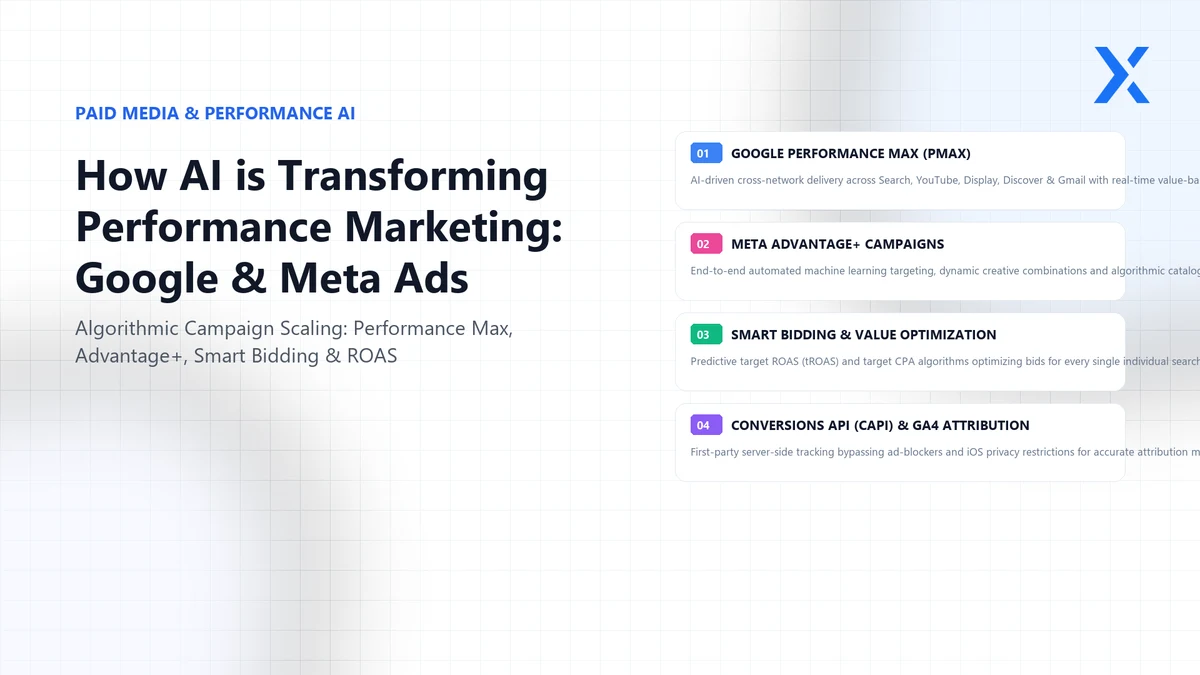
Performance marketing is anchored in measurable commercial returns: acquiring qualified leads, purchases, and subscriptions at a predictable customer acquisition cost. In today's competitive landscape, performance media buyers leverage artificial intelligence to automate bids, synthesize real-time auction signals, and iterate creative assets.
AI can dynamically adjust real-time bids to maximize conversion value and suggest high-performing copy angles based on millions of historical auction signals. However, relying blindly on algorithmic optimization without strategic direction is a recipe for wasted ad spend. Enduring profitability still demands bulletproof conversion tracking, strategic audience segmentation, compelling landing pages, and disciplined lead-quality evaluation.
How AI Supports Google Ads
Google Ads leverages machine learning through Smart Bidding (Target CPA, Target ROAS, Maximize Conversions) and automated formats like Performance Max (PMax). These models continuously evaluate auction-time signals—such as device, browser, intent query, and time of day—to calibrate bids.
However, algorithmic systems rely entirely on the accuracy of the feedback loops you establish. If you track casual page views instead of sales-qualified leads, Google's algorithms will aggressively spend your budget acquiring low-value clicks.
Essential Setup Checklist for Google Ads Campaigns:
How AI Supports Meta Ads
Meta’s Advantage+ suite uses deep learning to automate audience discovery, placements, and creative permutations across Instagram, Facebook, and Messenger.
When marketing a professional course or consumer service, you can deploy multiple creative angles highlighting practical projects, career acceleration, or flexible schedules. Meta's algorithms automatically route the right creative variation to the user most likely to respond.
Critical Warning: Never optimize solely for cheap clicks or superficial form fills. Continually audit downstream sales velocity and lead qualification scores to ensure automated campaigns attract genuine buyers rather than bot submissions.
AI for Ad Copy & Creative Development
AI tools enable marketers to draft dozens of hook angles, pain-point variations, and call-to-action iterations in seconds.
Before launching any automated creative into production, verify that the copy aligns with brand guidelines and legal advertising standards:
Quick Checklist for Reviewing AI-Generated Ad Copy:
- Is every performance claim accurate and provable with hard data?
- Are prices, offers, and warranty details clearly stated without fine-print deception?
- Have spelling, grammar, and tonal consistency been verified?
- Does the copy strictly comply with Google Ads and Meta advertising policies?
- Are absolute guarantees avoided unless backed by formal contracts?
- Is the call-to-action (CTA) compelling, distinct, and unambiguous?
- Are all regional industry regulatory guidelines observed?
Audience Research & Measurement Rigor
AI helps summarize customer transcripts, extract objection themes from review sites, and map intent segments. However, privacy regulations (such as DPDP in India and GDPR internationally) strictly govern customer data handling.
Never upload unhashed, sensitive customer PII into public AI tools. Only utilize secure enterprise data environments approved by your compliance team.
In performance marketing, optimization hinges entirely on accurate data attribution: server-side Conversion API (CAPI), UTM parameters, cost per qualified lead, and ROAS. Always cross-reference platform-reported metrics against your internal payment processor or CRM to prevent attribution inflation.
Practical Skills to Learn
A complete modern performance marketing skillset comprises:
- Audience & Keyword Intent Architecture: Identifying high-commercial intent search queries and psychographic buyer personas.
- Creative Testing Frameworks: Systematic multivariate testing across headlines, video hooks, and visuals.
- Landing Page CRO: Designing message-matched landers with friction-free lead capture mechanisms.
- Server-Side Conversion Tracking: Setting up Google Tag Manager (GTM), Meta CAPI, and GA4 custom events.
- Budget Management & Bid Pacing: Scaling profitable ad sets while aggressively capping underperforming creative.
- Responsible AI Prompting: Leveraging LLMs to generate high-converting variations while maintaining brand integrity.
Explore AI Digital Marketing Training
To learn how performance media buying connects directly with SEO, full-funnel content, and marketing automation, evaluate hands-on training courses led by experienced media buyers.
Read our comprehensive guide to AI digital marketing courses in Bangalore for full curriculum comparisons, fee benchmarks, and hands-on paid media projects.
Conclusion
AI can power performance marketing by automating bids, accelerating creative generation, and synthesizing performance trends. But marketers must still define commercial goals, maintain flawless conversion tracking, audit lead quality relentlessly, and steer campaigns with solid data.
Master AI-Powered Paid Advertising
Build real Google and Meta ad campaigns, configure conversion tracking, and optimize media spend with AcceleratorX's live 16-week program.