
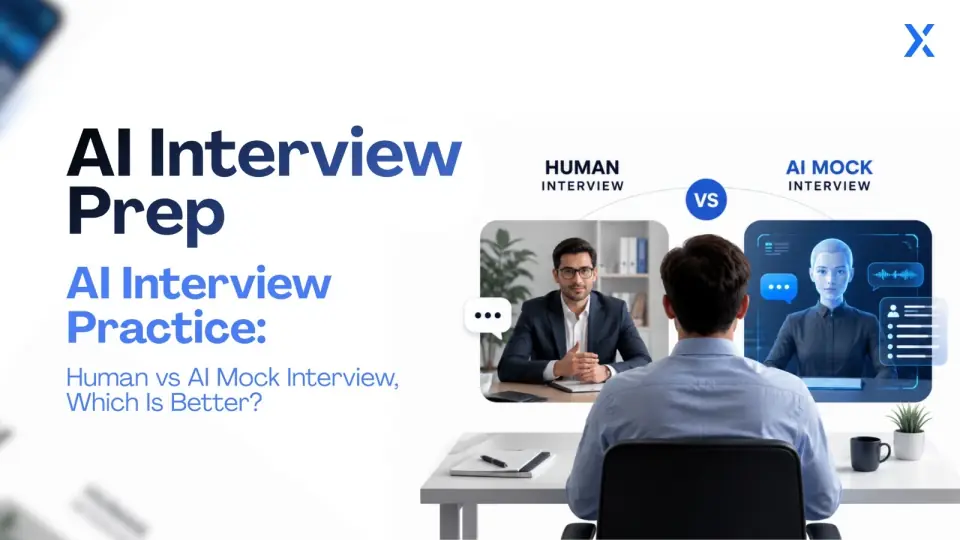
Getting ready for a job interview takes more than just reading typical questions and thinking about your answers. You should practise saying your answers out loud, handle follow-up questions, work on your communication, and get used to the pressure of an interview.
This is where AI interview practice can help. With an AI mock interview online, you can practise answering questions, get instant structured feedback, and repeat the process as often as you like — all without having to wait for a friend, mentor, or coach to become available.
But does AI interview practice work as well as practising with a human interviewer? The answer depends on what you are trying to improve. AI is helpful if you want to practise often, get quick objective feedback, and fit sessions into your busy schedule. But if you need nuanced judgment, company-specific advice, or deep human conversation, practising with a person still has its distinct benefits.
What Is AI Interview Practice?
AI interview practice means getting ready for job interviews by using artificial intelligence to simulate a realistic, interactive interview experience. Rather than just reading static question banks, you speak and answer in real-time as if you are facing a real hiring manager.
Depending on the platform, the AI can ask targeted questions tailored to your specific role, seniority level, or uploaded job description, delivering structured multi-dimensional feedback after every response.
Key Skill Areas Evaluated in AI Practice:
Today's top-tier AI interview practice platforms use natural voice interaction, adaptively generate intelligent follow-up questions based on your specific responses, and deliver deep rubric-based scoring.
How Does AI Interview Practice Work?
While individual software interfaces vary, most advanced online AI mock interview sessions follow a systematic 5-step workflow:
Select Your Target Role
Choose the specific job profile you are aiming for. Role-specific calibration is critical because an evaluation rubric for a Software Developer differs vastly from a Product Manager or Sales Executive.
Upload or Paste Your Job Description
Modern platforms allow you to provide the precise JD of the position you want. The AI parses the responsibilities, tool stacks, and leadership expectations to tailor ultra-relevant scenarios.
Start the Voice-Based Mock Interview
The AI agent asks situational, technical, and behavioural questions. You answer aloud into your microphone rather than typing — training your brain to articulate complex ideas under realistic time constraints.
Respond to Dynamic Follow-Up Questions
If your answer is too vague or introduces an interesting project claim, the AI triggers adaptive follow-ups (e.g., "How did you handle trade-offs between speed and system reliability during that project?").
Review Multi-Dimensional Performance Feedback
Immediately upon finishing, you receive comprehensive scores across Clarity, Structure, Relevance, Conciseness, and Confidence, paired with full transcripts and actionable rewrite recommendations.
AI Interview Practice vs Human Mock Interview
Many candidates wonder whether an AI mock interview can completely replace practicing with an experienced human coach. In reality, each method solves different parts of the interview preparation puzzle:
| Factor | AI Interview Practice | Human Mock Interview |
|---|---|---|
| Availability | 24/7 On-Demand | Requires advance scheduling |
| Practice Session Volume | Unlimited / High repetitions | Typically limited (1–3 sessions) |
| Feedback Delivery | Instant (per answer & end-of-session) | Delayed or summarized at session end |
| Evaluation Consistency | Objective, standardized rubrics | Subjective to interviewer's mood/bias |
| Personal & Qualitative Judgment | Limited to algorithmic parameters | Exceptional (spots authenticity & nuances) |
| Company-Specific Experience | Based on JD and online company data | Deep if mentor has worked at target firm |
| Cost per Session | Extremely low / Free trials available | High ($50–$300+ / session) |
| Repetition on Single Questions | Frictionless (drill the same question 10x) | Difficult / Awkward to repeat 10x |
| Real Human Pressure | Low pressure (safe sandbox) | High (simulates real interpersonal tension) |
Where AI Interview Practice Has an Advantage
1. Practice Anytime, Anywhere
You do not need to coordinate schedules with busy friends or mentors. Practise at 6 AM before work, during a lunch break, or late at night when a sudden interview invitation lands in your inbox.
2. Iterate on Weak Questions Repeatedly
If you stumble on "Tell me about yourself" or a tricky behavioral question, you can immediately restart and deliver 5 distinct versions until your delivery is crisp, structured, and under two minutes.
3. Track Quantifiable Progress
Consistent scoring criteria allow you to benchmark improvement across sessions (e.g., watching your Structure score climb from 5/10 to 8.5/10 as filler words decrease).
4. Eliminate Psychological Resistance
Many job seekers avoid mock interviews due to fear of judgment. AI provides a zero-judgment, confidential sandbox where you can make mistakes freely and build core confidence.
Where Human Mock Interviews Are Better
AI interview tools are outstanding for repetition and structure, but human interviewers excel at qualitative subtleties that algorithms cannot fully evaluate:
Detecting Over-Scripted Answers: An experienced hiring manager immediately notices when a candidate sounds like they are reciting a memorized script rather than thinking critically.
Assessing Commercial Context: A human coach evaluates whether your business judgment aligns with current industry realities, market dynamics, and team politics.
Pressure & Stress Testing: Human interviewers can deliberately challenge your reasoning to observe how your body language and composure hold up under intense interrogation.
Inside Company Culture Insights: Mentors who previously worked at Google, Amazon, McKinsey, or high-growth startups provide invaluable culture cues and unwritten hiring expectations.
AI Interview Practice vs Mock Interview Coach
Rather than viewing this as an "either/or" rivalry, top performers utilize both tools in a blended preparation strategy:
- Building initial speaking confidence and reducing anxiety
- Eliminating filler words and tightening answer length
- Practicing high volume (10–20 repetitions)
- Refining role-based standard behavioral & HR questions
- Final-round executive or leadership interview simulations
- In-depth system design, live coding, and case study debates
- Company-specific culture calibration and storytelling nuance
- Salary negotiation and counter-offer strategy
Who Should Use AI Interview Practice?
1. Students and Fresh Graduates
Ideal for campus placement drives and first-time job applications. Freshers can drill standard questions like "Why should we hire you?", "What is your greatest weakness?", and "Describe your final year capstone project."
2. Working Professionals & Career Switchers
Professionals transitioning between industries (e.g., moving into Generative AI and AI Engineering or Product Management) can practice articulating transferable skills and reframing past experience.
3. Independent Job Seekers
For candidates without access to paid executive coaches or professional mentorship networks, online AI tools provide world-class practice on a modest budget.
How to Get Better Results From AI Interview Practice
Doing a single mock session without a deliberate strategy won't yield noticeable progress. Maximize your return on investment with these actionable techniques:
Knowing an answer in your head is completely different from vocalizing it clearly under time pressure. Speak into your microphone and practice natural breathing, cadence, and eye contact.
Extract the key technical tools, leadership traits, and project methodologies listed in your target JD. Train the AI on that JD so every question reflects actual day-to-day expectations.
When responding to situational questions, structure your answers through the proven STAR framework:
If the AI flags that your answer took 4 minutes or was full of filler words, do not just click next. Re-record the answer immediately, targeting a concise 90-second delivery.
How Many AI Mock Interviews Should You Practice?
Starting your interview preparation 2 to 3 weeks before your scheduled date gives you adequate runway to identify deficiencies and build muscle memory. Here is a recommended practice roadmap:
Foundation & Baseline Scoring (3–4 sessions/week)
Run standard HR, introductory, and background questions. Benchmark your baseline scores in clarity, structure, and speaking pace.
Deep Dive on Role-Specific & STAR Scenarios
Feed specific company job descriptions. Drill complex situational, cross-functional conflict, and technical architecture questions.
One Full Dress-Rehearsal Simulation
Complete one full mock interview from start to finish without stopping to edit or restart. Treat it as the real thing.
Review Talking Points (Avoid Cramming)
Review your STAR bullet points and project metrics rather than memorizing rigid scripts. Focus on calm energy and confidence.
Common Mistakes During AI Interview Practice
Memorizing exact sentences makes you sound robotic. When interviewers interrupt with follow-ups, memorized candidates often freeze. Prepare key bullet points instead.
If the AI persistently notes that your answers lack concrete metrics or take over 3 minutes, implement the fix on the very next attempt rather than skipping ahead.
Real interviewers ask difficult follow-ups and probe failures. Ensure your AI sessions include high-difficulty questions on project failures and conflict resolution.
Knowing technical facts is only half the battle. If your explanation is disorganized or rushed, interviewers will assume you cannot communicate effectively with stakeholders.
Is AI Interview Practice Effective?
Yes, AI interview practice is highly effective when applied to the right preparation goals. It accelerates oral answer structuring, identifies repetitive speech errors, builds fluency, and removes the scheduling friction associated with mock interviews.
However, its effectiveness is directly tied to the sophistication of the tool you choose. Basic question generators that give generic feedback provide little real value. A superior AI platform must offer role-calibrated questions, context-aware follow-ups, and actionable rewrite recommendations.
What to Look for in an AI Interview Practice Tool
Before subscribing to an AI mock interview software, verify that it delivers the following essential capabilities:
Frequently Asked Questions
What is AI interview practice?
AI interview practice uses artificial intelligence to simulate job interview questions and provide feedback on your responses. Depending on the platform, you may practise through text, voice or video.
Is AI interview practice better than practising with a human?
AI is useful for repeated practice, immediate feedback and versatile scheduling. Human mock interviews can provide deeper personal judgment, more realistic interaction, and company-specific guidance. The better option depends on your preparation needs.
Can I practise interviews online with AI?
Yes. Online AI interview practice platforms allow you to practise from your computer or mobile device without scheduling a human interviewer.
Is AI mock interview practice useful for freshers?
Yes. Freshers can use AI mock interviews to practise common HR questions, behavioural questions, project discussions and communication before placement or job interviews.
Can AI interview practice help with technical interviews?
It can help with technical interview preparation, particularly for explaining technical concepts, discussing projects and practising structured responses. However, most AI interview platforms are limited when it comes to hands-on coding problems, real-time debugging, system design interviews, or whiteboard-style questions that require technical depth and interactive problem solving. For live coding exercises or in-depth technical discussions, seek practice with human coaches or dedicated coding environments.
What is the difference between an AI interview coach and a human mock interview coach?
An AI interview coach provides automated, repeatable practice and feedback. A human mock interview coach can provide personalised judgment, industry experience and further nuanced feedback.
How often should I practise with an AI interviewer?
Practise regularly rather than completing one session and stopping. Three to four sessions per week can provide useful repetition during the weeks leading up to an interview.
Can AI interview practice improve communication skills?
Yes. Speaking answers aloud and reviewing feedback may help you identify issues such as long answers, unclear explanations, poor structure and excessive filler words.
Final Verdict: Should You Use AI Interview Practice?
If you are getting ready for a job interview, it is a smart strategy to include AI interview practice in your preparation routine. It gives you a practical, cost-effective way to practise repeatedly, work through role-specific questions, and eliminate speaking weaknesses before your actual interview.
Use AI for what it does best: repetition, structured feedback, and regular practice. Combine it with human coaching when you need detailed qualitative judgment, company-specific culture advice, or final-round leadership prep.
A proven interview preparation cycle is:
Practise → Receive Feedback → Identify Weaknesses → Improve → Practise Again.
That virtuous cycle is what transforms interview prep into a real, dependable career skill.
Experience real-time voice practice, role-specific questions, and instant feedback with our AI mock interview online platform.