
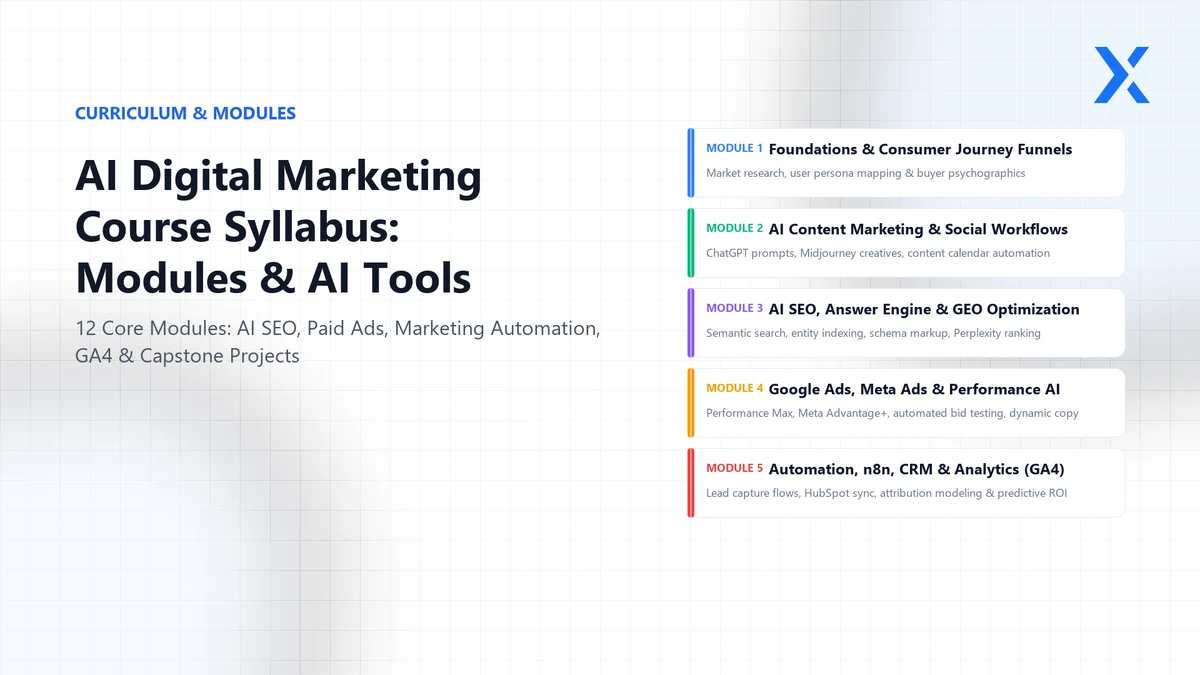
Artificial intelligence is revolutionising how firms approach SEO, paid ads, content, social media, and customer engagement. For example, AI can target ads to specific audiences and suggest hyper-relevant content to website visitors. Learning how to use AI in digital marketing trains students and graduates with the practical, modern skills needed for today's high-demand marketing roles.
Before you sign up for a course, make sure you know what the syllabus covers, what tools you'll use, what the practical assignments are, and what you'll actually learn. Ask yourself questions such as: Does it involve real projects, or are they just simulated? Are the AI tools used in the course up to date? Will you get any practical experience? Does it actually show you how to use your skills in a real marketing context?
A good AI digital marketing course will teach you the fundamentals of marketing and give you hands-on experience with AI workflows across channels.
What Should an AI Digital Marketing Course Syllabus Include?
A modern syllabus should bridge foundational marketing theory with cutting-edge AI implementation. Here are the core pillars that every comprehensive AI digital marketing syllabus should feature:
1. Digital Marketing Fundamentals
If you're new to digital marketing, start by learning how it works from first principles. This section typically covers audience research, consumer psychology, the customer journey, marketing funnels, conversion objectives, and campaign planning. These fundamentals help you understand where and how AI fits into a wider business growth strategy.
2. AI-Powered Search Engine Optimisation
SEO remains key to getting discovered organically online. AI can assist with keyword research, search intent analysis, content briefs, competitor research, and content optimisation. You should also look at technical SEO, on-page optimisation, internal linking, schema markup, and how to track performance via Google Search Console and analytics platforms.
3. AI Content Marketing
AI can assist with content planning, topic clustering, blog outlines, content calendars, and iterative editing. However, it's still essential to fact-check, bring your own experience and domain expertise, and ensure the content you produce is uniquely useful to your readers. One practical exercise is devising an end-to-end content strategy for a live business website.
4. Paid Advertising and Campaign Optimisation
This module covers Google Ads, Meta Ads, audience targeting, campaign setup, ad copy variations, conversion tracking, and results analysis. AI can generate creative ideas and identify hidden patterns in campaign performance, but the marketer still needs to review targeting, budget allocation, and lead quality.
5. Social Media Marketing
You need to learn how to plan social media campaigns, create platform-native content, schedule posts systematically, and measure community engagement. AI can handle ideation, hook generation, and content repurposing to save substantial time, provided you review and refine the output with your brand voice.
6. Marketing Analytics and Automation
Analytics training should cover traffic acquisition, engagement, conversions, attribution models, and campaign ROI. You should master Google Analytics 4 (GA4) and modern reporting dashboards. Automation lessons should cover lead management, automated email workflows, and connecting marketing systems to remove repetitive friction.
Practical Projects to Look For
A curriculum without practical execution is only theoretical. Look for a program that requires you to build tangible marketing assets you can showcase to employers or clients:
Website SEO Audit
An in-depth SEO audit of a local business website evaluating technical health, keywords, and on-page signals.
AI-Assisted Content Strategy
A comprehensive brand content strategy featuring topic clusters, research briefs, and audience intent mapping.
Google Ads Campaign Simulation
A structured paid search campaign plan with ad variations, negative keywords, bidding strategies, and landing pages.
Social Media Campaign Calendar
A 30-day cross-platform content schedule tailored to platform nuances, tone of voice, and conversion goals.
Marketing Performance Report
A data-driven analytics dashboard breaking down channel attribution, CPA, CAC, conversion rates, and ROI.
Lead Generation Automation Workflow
An automated lead nurture pipeline integrating web forms, CRM, automated email sequences, and webhook routing.
How to Choose the Right Course
To find the right course, use a systematic approach. Create a checklist of factors that matter to you: syllabus depth, trainer experience, practical hands-on work, tools covered, mentorship support, course duration, and total fees. Prioritise what matters most for your individual goals, then evaluate potential programs against your checklist.
Always verify whether you will be working on realistic business projects or merely passively watching lectures. This makes all the difference when demonstrating your capabilities during job interviews.
For a broader overview of course options, institutes, fee structures, and learning considerations, explore our detailed guide on AI digital marketing courses in Bangalore.
Conclusion
An AI digital marketing course syllabus should strike a balance between marketing fundamentals and modern AI tooling. Look for a program that places a strong emphasis on practical projects, transparent performance measurement, and responsible AI use.
Responsible AI use means applying artificial intelligence ethically: generating original, credible content, safeguarding user privacy, and utilizing automation thoughtfully rather than blasting generic output. When evaluating your options, ensure the curriculum prepares you to think strategically, execute decisively, and deliver verifiable business results.
Ready to Master AI Digital Marketing?
Explore AcceleratorX's live 16-week AI Digital Marketing Program. Learn directly from industry leaders, master AI prompting, automate marketing funnels, and build a standout portfolio.